Fifty years before Charles Darwin published On the Origin of Species and triggered a scientific, social and religious earthquake, a theory of evolution had already been published. But Jean-Baptiste Lamarck’s evolutionary theory mostly provoked ridicule – including from Napoleon, no less – and hasn’t got many better reviews since.
Darwin’s theory was that organisms born with advantageous mutations will be better able to reproduce, thus making the mutation more common until its holders constitute an entire new species. Although he lacked a mechanism to explain how, both the fossil record and observations in nature and the lab backed him up. The discovery of DNA provided the long looked-for mechanism.
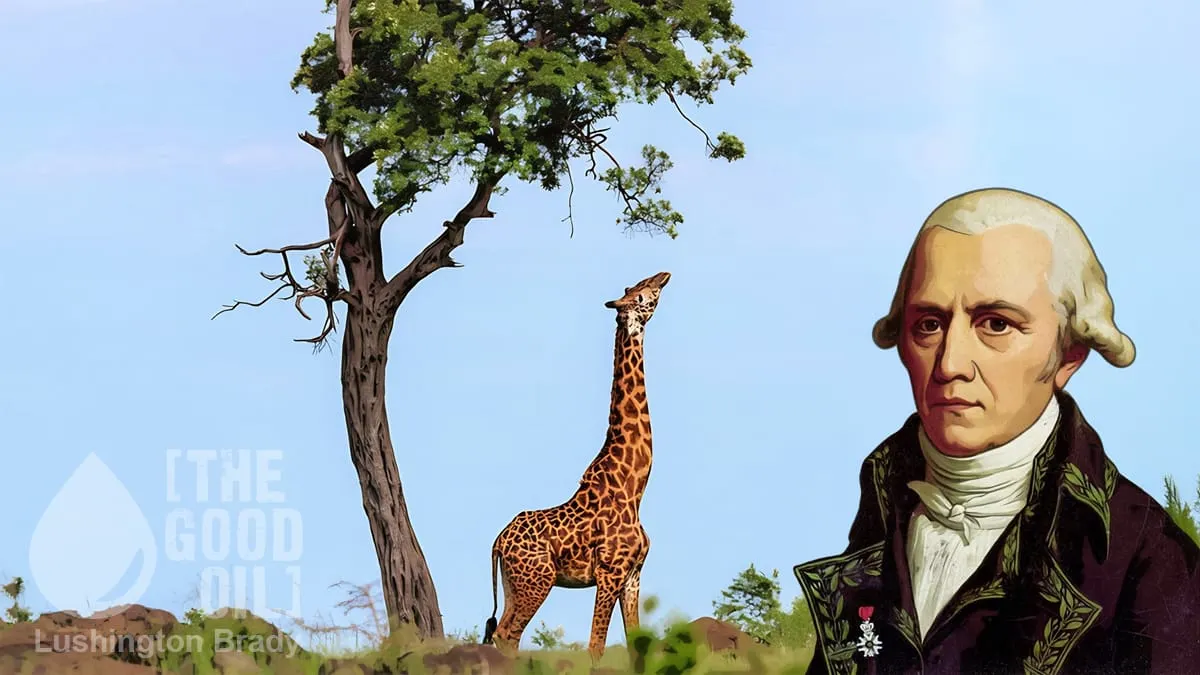
But Lamarck’s theory was that organisms can pass on physical changes acquired during their lifetimes on to their offspring. For instance, a giraffe that constantly stretched its neck up to reach higher leaves would give birth to longer-necked offspring. A blacksmith who developed bulging biceps would have similarly ripped sons. Lamarckism never attracted much credibility and has been looked upon as a pseudo-science for 200 years. August Weismann is credited with falsifying the theory in 1904, in which he amputated the tails of mice, then bred them. Their offspring had perfectly normal tails.
Is it time, though, to give Lamarckism another look? A small but noisy band of academics thinks so.
In an essay published this week, Prof Pim Edelaar, a professor of evolutionary biology and genetics at the University Pablo de Olavide in Spain, pointed to examples of the theory at work in worms and killer whales.
He wrote: “It is time to embrace Lamarckism again.”
Prof Richard Buggs, a professor of evolutionary genomics at Queen Mary University of London, said there was a “growing acceptance” within the evolutionary biology community of evidence to support Lamarckism.
Edelaar points to tiny worms that produce RNA molecules in response to stress or infection and then pass some of those molecules to their offspring, giving the next generation a head start against the same threats. He also cites killer whales that learn new hunting techniques and teach them to their calves. Both of those are not exactly reasons to get excited about Lamarckism. What we are actually looking at is epigenetics and cultural transmission, not a resurrection of Lamarck’s core claim.
Epigenetic marks – chemical tags that switch genes on or off without altering the DNA sequence itself – can sometimes be inherited for a generation or two. That is real, measurable and scientifically interesting. But it is not the permanent, cumulative change that builds new species. Most of these marks are wiped clean in the germline. They are temporary adjustments, more like a dimmer switch than a redesign of the wiring. Calling every short-lived epigenetic tweak ‘Lamarckian evolution’ is rather like calling a temporary suntan a change in race (to be fair, a strategy which has paid off handsomely for plenty of fake ‘indigenous’ activists).
The killer-whale example is even thinner. Teaching offspring to hunt seals instead of salmon is cultural learning. Birds do it. Humans do it. But this is, at best, memetics, not genetics. It is fascinating behavioural ecology, not the inheritance of an acquired physical characteristic. Lamarck was talking about the blacksmith’s biceps becoming hereditary, not the blacksmith teaching his son how to swing a hammer.
Darwin’s framework still accounts for the overwhelming majority of evolutionary change we observe in the fossil record, in laboratories and in the wild. Soft inheritance via epigenetics is a modest footnote, useful in certain narrow circumstances, not a ‘second driver’ on equal footing. The textbooks that still call classical Lamarckism wrong are not outdated: they are simply refusing to confuse a useful modern discovery with an old theory that got the mechanism fundamentally backwards.
There is a recurring temptation in biology, as in every other field, to rehabilitate the discarded idea and claim the orthodoxy has been overthrown. Sometimes the orthodoxy deserves it. More often the rehabilitated idea is being stretched until it snaps. Over-egging the pudding does no one any favours, least of all the science.