

Simon O’Connor
Husband, step-father, foster dad, and longtime student of philosophy and history. Also happen to be a former politician, including chairing New Zealand's Foreign Affairs, Defense, and Trade Committee.
Spoilers. If you haven’t seen The Odyssey in theatres yet and don’t want any surprises, then step away now. Like the Sirens on the coast, block your ears (and in this case, close your eyes) and move on.
Commenting on Christopher Nolan’s adaptation of The Odyssey seems to be the fashionable thing to do at present, so I thought I would join in with the enthusiasm of the suitors in Ithaca or perhaps the naivety of the crew visiting Circes.
From the outset, I will say I both enjoyed the film and many of the themes within.
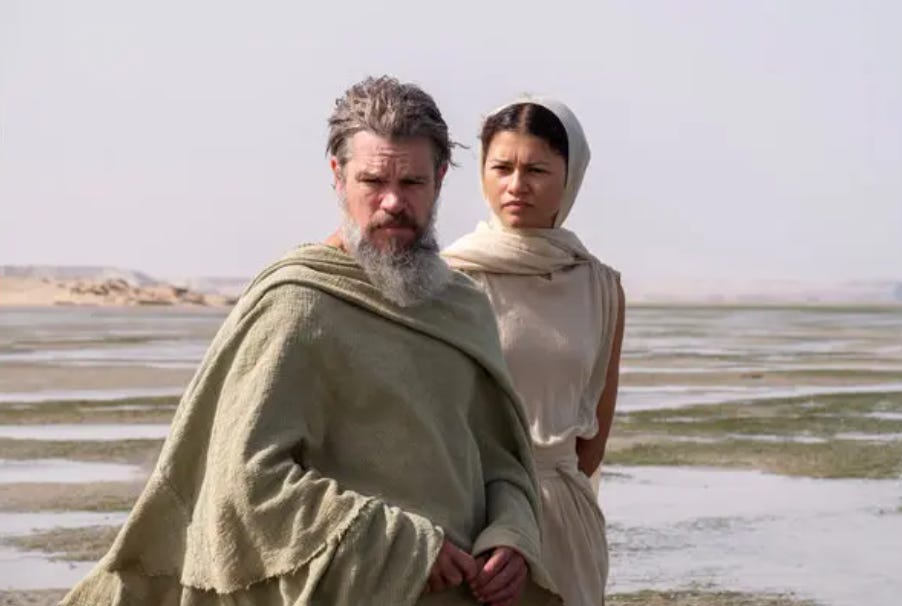
I note many online commentators have already tried to situate the film as some grievance-based political activism. Neither are true and people would do well to hold their opinions until they’ve actually seen the film. Furthermore, those with ideological agendas should also refrain from trying to twist what Nolan has done to fit their narrative. I am thinking particularly of some on the right still getting upset that Helen is portrayed by Lupita Nyong’o, of Ghanian descent. These objections are both unbecoming and unnecessary as I will write later.
As I’ve done, I’d also encourage people to actually read Homer’s poem before thinking about critiquing it.
The film is not without criticism. For me, it was too long at two hours and 53 minutes and I felt there was little virtue attributed to Odysseus. He was driven by love to a degree, but mostly regret, confusion, and rage. I suppose I’m saying that Matt Damon’s depiction of Odysseus was not overly noble. He was certainly not a protagonist to warm to. I would say we could relate to him to some degree, but relating is not the same as liking.
An overarching theme for Homer should also familiar to us moderns today. For Homer, why are the gods bad to us – punishing us? To the moderns, why does God (as in the Christian Trinitarian God) allow suffering and to what degree are we just adrift on the sea, as Odysseus was, due to our own faults?
I very much liked how the character of the god Athena was in the form of a Trojan princess who was executed in front of Odysseus after the sack of Troy. There is a strong aspect of conscience in this depiction, with the ‘god’ really being a manifestation of a deep human sense of right and wrong. It is perhaps no surprise the manifestation is one of pain, and not one of celebration. Odysseus’s memory and sense of right and wrong is manifested in a moment of pain and regret, not celebration and victory.
There is also a hint of the Blessed Virgin Mary insofar as Athena is drawing Odysseus to home, very much akin to how Mary is always drawing people towards Christ. If you have not noticed in Marian imagery – be it icons, pictures, or statutes – the Virgin Mary always has Jesus with her, and always looking or pointing at him. I acknowledge of course, this is me reading into the depiction, as naturally Homer, when he wrote this poem, was well before any Christian era.
I really responded to the key themes around the desire to be home, to love, and to have legacy. This is mostly what drove Odysseus and his crew, though as with real life, not all get to achieve these goals.
I would argue that while we all want justice, the world is not just. Homer delves deeply into this and Nolan does as well. It’s not just that Odysseus got home and his crew did not. We also see the injustice continue when Odysseus and the crew visit Hades (the Greek conception of hell) and the dead remain angry and violent. This is the antithesis of the Christian perspective, though, and one reason many believers seek justice daily, but are not without hope when it is not manifest.
The Christian view is that there is a new heaven and earth, a chance for redemption, and a restoration of justice. Granted, this is a belief system but for those of us with a theological bent, the pagan Homer’s depiction of Hades (as told by Nolan) is truly terrifying. There is never justice, never rest – just perpetual grievance, which in many ways, is how many of the woke and progressive activists live their lives today.
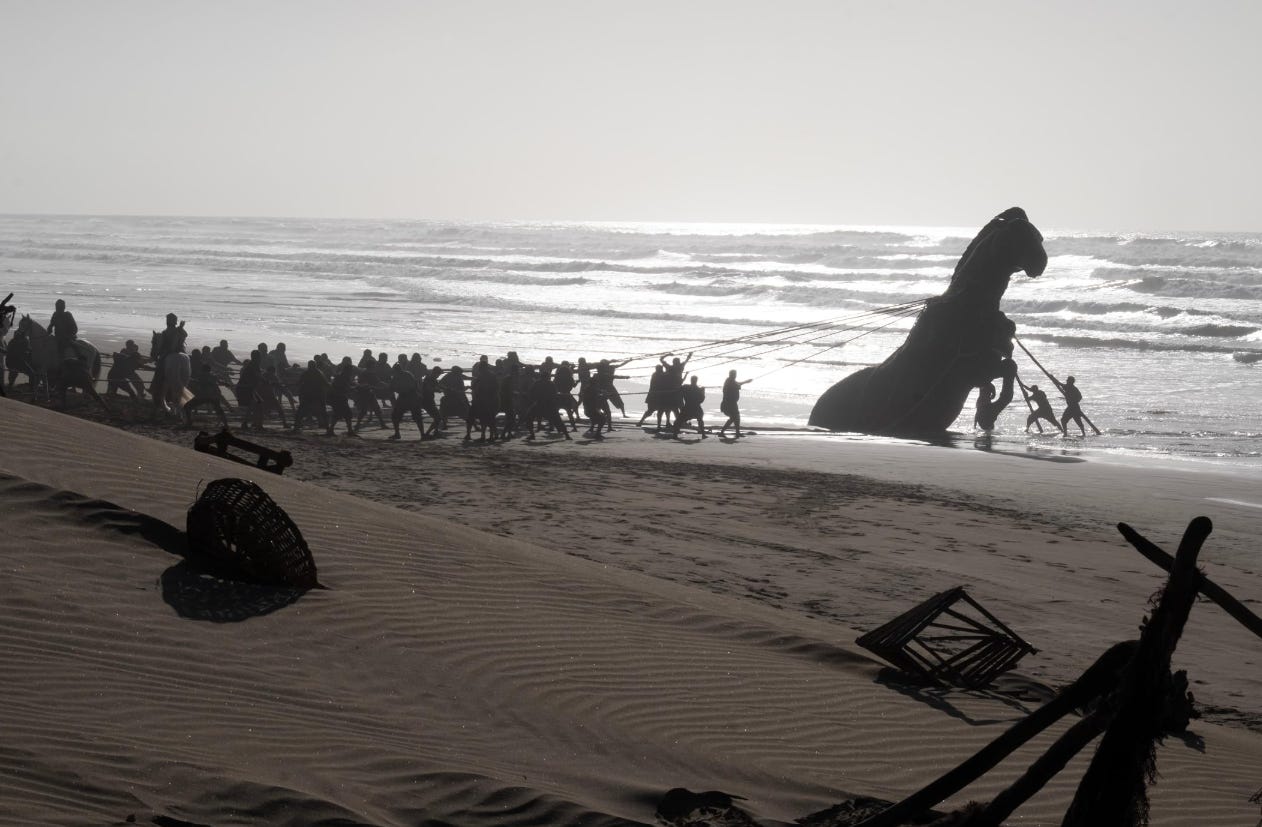
Helen is fascinating because she is ultimately treated more as an idea than a person. The tragedy is not simply that she is beautiful but that others use her beauty for their own ambitions. That she is black is completely irrelevant to me and I find all the commentary around it totally unnecessary. What is more striking is that her being the most beautiful woman in the world is clearly not the reason for the Trojan war. Beauty is colour blind but we also see her, depicted in the film, as half scarred. I liked the line from Menelaus, where he says she can only now launch 500 ships. Love of her has scarred her, mostly as she was misused as the reason for the war. We often fight for illusions or a romantic view of things, and this confusion can lead to both harm and even zealotry. The more we detach ourselves from truth, then ‘love’ becomes confused. This is the case with Helen and the Trojan war. She was not truly loved, but used, and this disfigured her and caused the Greeks untold death and harm.
Equally, much was made of Elliot Page1 depicting the character Sinon. For all the uproar from some, I thought a character that was unknowingly living a lie; tormented isolation; was certainly the opposite of what Sinon was supposed to be (a great strong warrior, which he certainly is not in Nolan’s depiction); and not confronted with the truth from his comrades – is a perfectly analogy of the transgender madness. That Sinon remains tormented in Hades is also telling and sad.

Homer and Nolan’s depiction are also very clear that there are human boundaries. The Greeks thought of the gods, and their often arbitrary interaction with humans, but they still guarded various boundaries. Modern critical theory and intersectionality buys into the opposite – that there are no gods or boundaries, but just endless concepts for us to create. As Odysseus and his men found out, all the best intentions in the world will not save you from the reality of consequences.
Finally, I thought the place of superstition in the film was fascinating. Odysseus’s men turned against him, scapegoated and blamed him due to their superstitious beliefs in the gods, notably Poseidon, god of the sea. For those who read Rene Girard, the irony is that while those who seek to blame another for the failings around them, even kill them, end up apportioning the blame they usually suffer. Those scapegoating fail to recognise the reality of what is happening, but instead seek a convenient – often superstitious – explanation for things. Here in New Zealand, we are seeing a return of superstition as people seek out paganism, the occult, or ideas such as vitalism (that everything has a life force). Superstition leads to whirlpools and rocks, and not always for the intended victim but the superstitious themselves.
Desire, scapegoats, and death ...Simon O'Connor 5 September 2024 Read full story
The Odyssey was a good watch. It’s not great in my opinion insofar as not in the ‘greatest movie of all time’ category, but a good attempt to relate the poetic genius of Homer to our modern world.
Go watch it if you can or, better still, read the poem.
1 I think it is an important courtesy to use the name someone choses. But, for clarity, Elliot Page is not a man, she is a biological woman.
This article was originally published by On Point.




![[The Good Oil] Stuff Up of the Day](https://storage.ghost.io/c/31/f4/31f4e20a-0315-499e-83ff-139e8eab53bf/content/images/size/w1304/format/webp/2024/09/Stuff-up-image-1.webp)
