Table of Contents
In the 2012 presidential debates, Republican candidate Mitt Romney pointed out the worrying decline of America’s blue-water fleet. With his trademark smugness, Obama haw-haw-hawed that “we also have fewer horses and bayonets”. The media chatterers dutifully guffawed along. Oh, those fuddy-duddy Republicans – get with the times! A decade later, with an increasingly aggressive China trying – and largely succeeding – in turning the Pacific into Xi Jinping’s personal boating lake, who looks the fool, now, Barry?
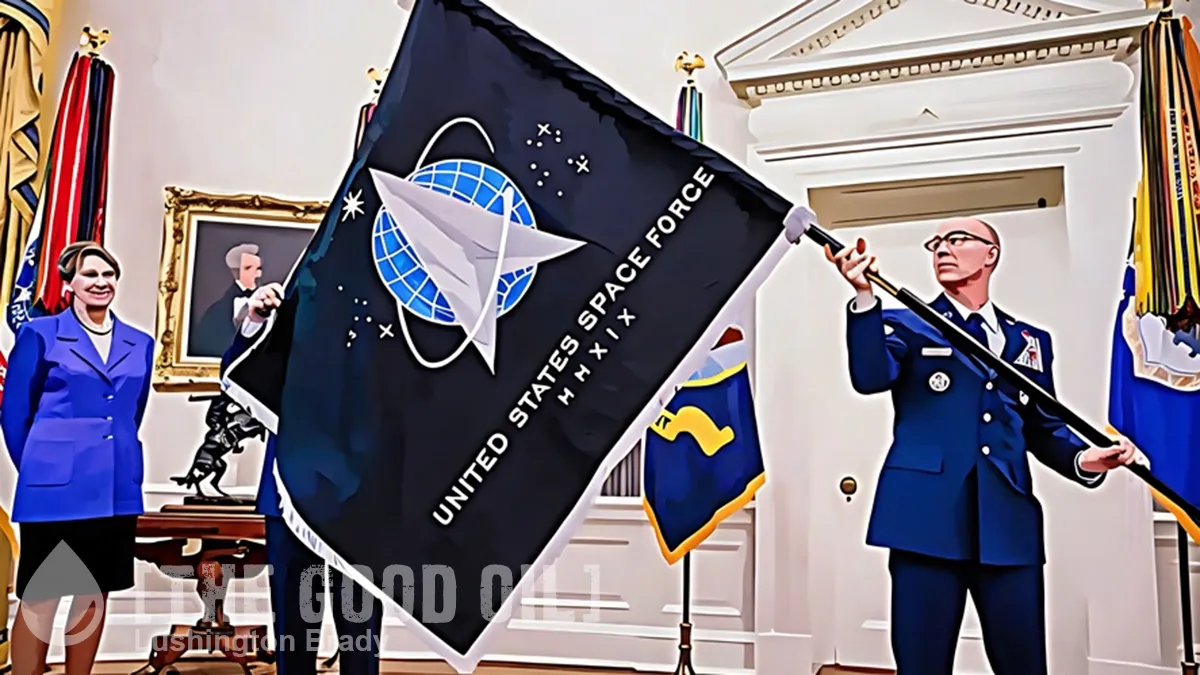
The left aren’t the fastest learners, though (what can you expect from people who still think socialism will work ‘this time’?), so when Donald Trump founded the newest branch of the US military, the Space Force, the same witless loons dutifully guffawed and sneered. They’re being proved wrong faster than the ol’ O’Bomber was.
This is how the next war could start: invisible shots fired in space on the electromagnetic spectrum that could render US fighter jets and aircraft carriers deaf and blind, unable to communicate. In this case, the “aggressors” targeting the US satellite were not from China or Russia, but rather an elite squadron of US Space Force Guardians mimicking how potential adversaries would act in a conflict that begins in orbit.
The July combat training exercise marked the largest one led by the Space Force, the highly secretive branch of the military with an exclusive focus on combating threats in the vast expanse beyond Earth’s atmosphere.
More than five years after it was created, the Space Force, the most derided and misunderstood branch of the US military, has emerged as a vital part of the American war machine as space becomes increasingly militarized. But even its leaders acknowledge that they are still honing their mission while jousting with adversaries, such as China, that are moving quickly and conducting combat-like operations in orbit.
The left may be totally ignorant about the potential of space-based warfare, but America’s enemies very much are not. In fact, the US Space Force is playing a desperate game of catch-up.
But while it has made progress since its founding in 2019 as the first new branch of the military since the Air Force in 1947, the Space Force has struggled to gain its footing and widespread respect among most of the American public, in many corners of Congress and even inside the Pentagon, as it looks to bolster its reach deep into space.
With a budget of just $40 billion, the relatively tiny Space Force makes up just about four per cent of the Defense Department’s budget and less than one per cent of its personnel. It has more than 15,000 guardians, which also includes several thousand civilians. By comparison, the army has nearly one million soldiers. The Space Force has been squeezed under the department of the Air Force and struggled to distinguish itself from the other branches.
Even its mission is unclear, with some arguing it needs to be focused on fighting war in space, and others saying it should use spacecraft and orbital weapons to support forces on the ground.
While the Space Force continues to evolve, many defense analysts and some members of Congress fear the United States has already ceded its dominance in space to China and others […]
“Our adversaries have progressed so fast in the last few years that this is not a theoretical discussion about how we would support combat on the ground,” [Gen Chance Saltzman, the Space Force’s chief of space operations] said in an interview. “This is now a real-world operational challenge where we know that the space domain will be contested if we get into a crisis or conflict in the future.”
When Obama mocked the decline of the US Navy, he forgot – or didn’t care about – the single blackest day in American history: 7 December, 1941. For failing to comprehend Japan’s determination in the Pacific, the US paid badly in blood, treasure and a long delay to catch up in the war that ensued. As early as 2001, Donald Rumsfeld was warning of the growing danger of a “space Pearl Harbour”. It took nearly another 20 years for a president to listen.
But despite decades of warnings, in what many defense analysts now say was a strategic blunder, the Pentagon did little to treat space as a contested environment. China, Russia and others have demonstrated that they can take out or interfere with the satellites operated by the Pentagon and intelligence agencies that provide the nation’s missile warning and tracking, reconnaissance and communications.
China in particular has moved rapidly to build an arsenal of space-based weapons, at a pace that Saltzman has called “mind-boggling.”
China has launched over a thousand satellites, including likely ‘satellite killer’ platforms. It’s testing hypersonic ballistic craft and operating a space plane, similar to the US X-37B, which stays in orbit for months at a time, performing highly secretive manoeuvers. China has also practised manoeuvres to capture or attack satellites, and even ‘satellite dogfighting’.
A Russian test of a satellite-destroying missile in 2021 created a cloud of debris that threatened the International Space Station. Russia has also been operating a potential test bed for nuclear anti-satellite weapons. In the meantime, it has routinely jammed signals from US GPS satellites in the Ukraine war.
Generals are too often accused of fighting the last war. If it was up to the left, they’d be left fighting the first space-based war with horses and bayonets.




![[The Good Oil] Stuff Up of the Day](/content/images/size/w1304/format/webp/2024/09/Stuff-up-image-1.webp)