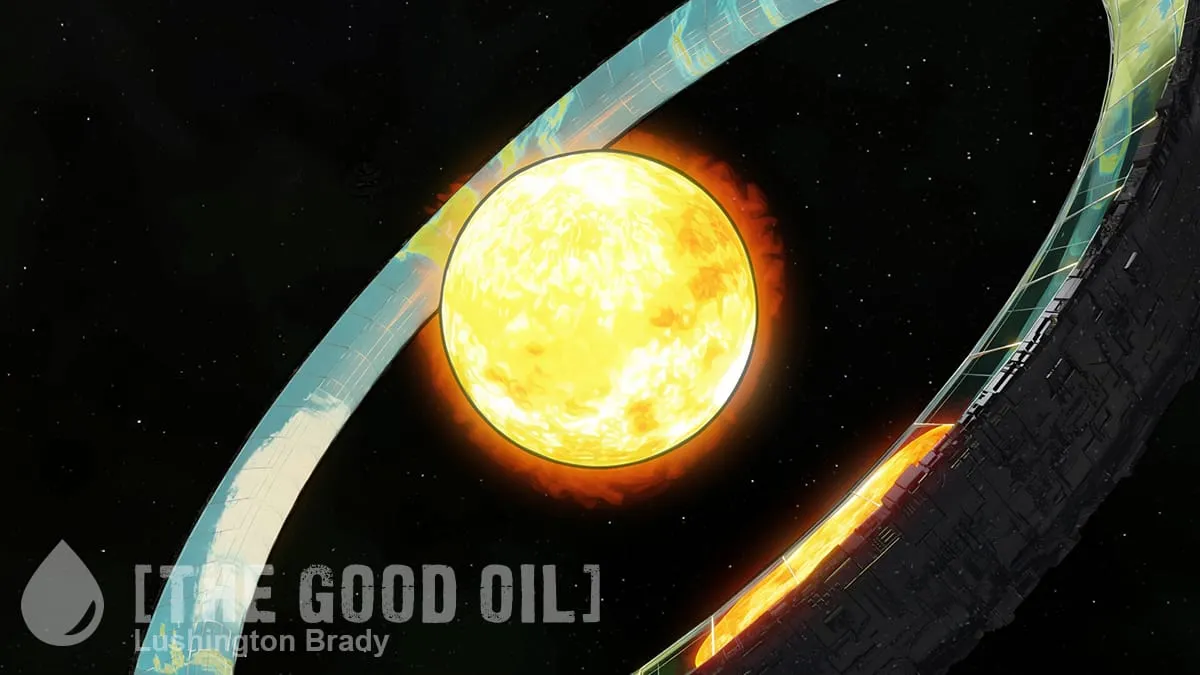
Larry Niven’s Ringworld is a classic of what is known as the “Really Big Thing” sub-genre of science fiction (other examples include Arthur C Clarke’s Rendezvous with Rama and the Death Star from Star Wars). The Ringworld is a 300 kilometre circular structure with a sun at its centre: basically like a Halo ring, but smaller and with its own sun. As such, it has about three million times the surface area of Earth. In fact, it has an entire reconstruction of the Earth’s continents, laid out in a 1:1 scale Mercator-like projection, in just one of its oceans. (It also has the best-named spaceship in SF: The Lying Bastard.)
Niven conceived the Ringworld as a partial Dyson sphere. Dyson spheres were proposed in 1960 by physicist Freeman Dyson, as a potential solution to an advanced civilisation’s energy problems. The idea is that a star’s planets are demolished and their material used to construct an enormous sphere enclosing the star at an appropriate ‘Goldilocks zone’ distance. In this way, 100 per cent of the star’s energy can be harvested.
While human technology is nowhere near capable of constructing a Ringworld, let alone a complete Dyson sphere, putative advanced aliens might. If they did, they’d leave telltale signatures that could be detected across the light-years, which is exactly what some astronomers are doing, with the James Webb Space Telescope.
What would those tell-tales be?
“Waste heat. That is the whole game,” astrophysicist Olivia Curtis of Pennsylvania State University, co-author of a preprint describing the analysis, told ScienceAlert.
“A civilization can hide its star behind a shell of solar collectors, but thermodynamics always collects its tax, and all that captured starlight has to come back out as a warm mid-infrared glow.”
That glow would be unavoidable. Just as a laptop or lightbulb gives off waste heat, so too would any machine that harvests a star’s energy. The larger the hypothetical megastructure, the brighter that excess infrared radiation should become.
Project Hephaistos, led by astrophysicist Erik Zackrisson of Uppsala University in Sweden, set out to look for stars that are too bright in mid-infrared for the visible light they give off.
The search sifted through roughly five million Milky Way stars looking for exactly this kind of infrared excess – more mid-infrared light than an ordinary star should produce.
Seven stars survived the team’s increasingly stringent tests, with the two studied here emerging as the search’s most compelling candidates.
As it turned out, both were ‘imposters’. The explanation was as simple as it is nonetheless impressive: the stars in question were almost perfectly lined up with a distant galaxy, unusually bright in infrared, behind them. In effect, the star hid the galaxy, except for the galaxy’s infrared, which then appeared to be radiating from the star.
The older WISE telescope, which first flagged them, lacked the resolution to separate the two sources. It saw one object with a puzzling infrared excess and dutifully handed the mystery to the next generation of instruments. JWST’s images settled the matter in short order.
“At the shortest wavelength you mostly see the star, and as you step out to 10 and then 15 microns the star fades away while a second source right next door lights up. The moment you see two sources where WISE saw one, you know the star was never the thing glowing, and the spectra only confirmed what the pictures had already given away.”
These weren’t just any background galaxies. Both are exceptionally bright in infrared light, exactly the wavelengths astronomers search when hunting for the waste heat of a hypothetical Dyson sphere […]
“The Universe hid that galaxy about as well as it possibly could have, and I respect it a little for that.”
So, no aliens this time. Just two more examples of the Universe’s talent for coincidence and misdirection. Still it wasn’t entirely a waste of time: the team developed new techniques for untangling blended light and working around JWST’s limitations.
Future searches now inherit the newly minted toolkit. Whatever survives the next gauntlet will have earned real attention.