Table of Contents
Greg Bouwer
IINZ
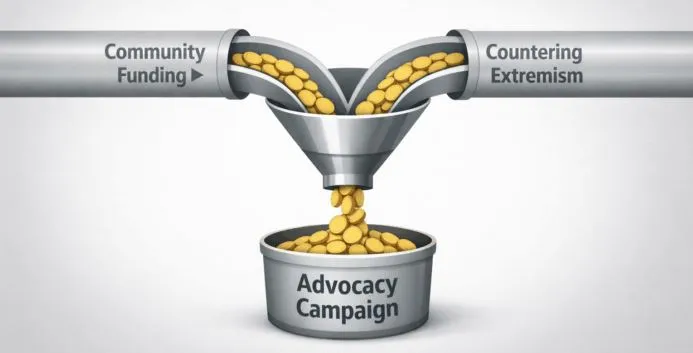
Official Information Act material indicates that $30,000 from the Ethnic Communities Development Fund was allocated to support a campaign advocating for a ceasefire in Gaza and promoting allegations of genocide against Israel. Financial statements filed on the Charities Register further indicate that the same organisation may have received approximately $70,000 from the now-disbanded Preventing and Countering Violent Extremism Fund for related activity. These disclosures point to something that cannot be easily explained as an administrative anomaly: two separate funding streams, designed for distinct purposes, converging in support of a single, politically charged advocacy effort.
From Community Support to Political Advocacy
The Ethnic Communities Development Fund exists to support participation, inclusion, and wellbeing across New Zealand’s diverse communities. Its legitimacy rests on neutrality. It is not intended to fund political advocacy, and its own criteria explicitly says so.
A campaign aimed at shaping public opinion on an ongoing foreign conflict – particularly one advancing legal claims such as genocide – cannot plausibly be characterised as apolitical. It is advocacy in the clearest sense: directed, persuasive, and situated within a contested international debate.
If such a campaign falls within scope, then the definition of “non-political” has been stretched beyond recognition. If it does not, then the question becomes how it was approved.
Either way, the boundary between community support and political advocacy appears to have been blurred.
The PCVE Fund and the Problem of Category Collapse
More striking still is the apparent involvement of the Preventing and Countering Violent Extremism Fund.
The PCVE framework was established with a specific and serious purpose: to reduce the risk of radicalisation and strengthen social cohesion by preventing the conditions under which violence can emerge. It belongs to the domain of public safety, not political discourse.
To use such a framework – if that is indeed what occurred – to support advocacy centred on a highly polarising international conflict would represent a profound category error.
It would mean that a mechanism designed to reduce extremism has potentially been used to amplify one side of a deeply contested narrative. It would suggest that political messaging is being recast as a form of social protection, and that the boundary between safeguarding communities and shaping their political views has begun to dissolve.
That is not a minor procedural issue. It is a conceptual shift.
And it carries a certain irony: that a fund intended to strengthen cohesion and resilience may have been used, however inadvertently, to support activity that risks deepening division.
When Separate Systems Converge
What makes this situation particularly difficult to dismiss is the convergence of funding pathways.
These are not overlapping programmes with similar mandates. They are distinct mechanisms, established for different purposes, administered under different rationales. One is concerned with inclusion and participation; the other with preventing extremism.
Yet both appear, on the available information, to have supported the same or closely related advocacy activity.
When separate institutional systems arrive at the same outcome, it is rarely the result of coincidence alone. It suggests that the issue lies not in a single decision, but in how criteria are being interpreted – or how boundaries are being understood – across the system as a whole.
Neutrality, Selectivity, and the Question That Follows
This leads to an unavoidable question: would funding have been equally available for alternative perspectives on the same conflict?
If a campaign emphasising Hamas’s conduct, or the complexities of urban warfare, or the strategic arguments against a ceasefire had applied under the same frameworks, would it have been treated similarly?
If the answer is no, then neutrality has been compromised. If the answer is yes, then the scope of public funding has expanded into the financing of political contestation itself.
Neither outcome is trivial. Both require explanation.
The Domestic Consequence of Imported Conflicts
New Zealand’s strength as a pluralistic society lies in its ability to accommodate diversity without importing external conflicts wholesale into domestic life.
That balance depends, in part, on the restraint of public institutions. When the state is seen to fund one side of a contested international issue, it does not merely support a project. It signals alignment. And once that perception takes hold, the consequences are predictable: trust erodes, communities polarise, and conflicts that originate elsewhere are reproduced here.
Neutrality is not an absence of values. It is the condition that allows multiple values to coexist without state endorsement of one over another.
What Needs to Be Clarified
The response to this situation should be measured, but it cannot be passive.
At a minimum, there must be transparency about how these funding decisions were made, including the criteria applied and the reasoning used to assess the application. There must also be clarity about how “non-political” objectives are defined in practice, and whether those definitions remain meaningful when applied to real-world cases.
More fundamentally, there must be a reaffirmation – or reconsideration – of the boundary between community support and political advocacy. If that boundary is no longer being maintained, then it should be openly acknowledged and debated, not quietly reinterpreted through administrative practice.
Conclusion: The Irony at the Centre
This case is not ultimately about Gaza, or Israel, or any single campaign.
It is about whether public institutions can maintain the distinctions on which their legitimacy depends.
A fund designed to support communities appears to have supported political advocacy. A fund designed to prevent extremism may have supported activity that deepens political division. Each step, taken in isolation, might be explained. Taken together, they point to something more concerning: not deliberate partisanship, but the erosion of the boundaries that prevent it.
The irony is difficult to ignore.
Mechanisms created to strengthen social cohesion may, in this instance, have been used in ways that risk undermining it.
That is not a question of intent. It is a question of standards.
And it is one that deserves a clear answer.
This article was originally published by the Israel Institute of New Zealand.