
Simon O’Connor
Husband, step-father, foster dad, and longtime student of philosophy and history. Also happen to be a former politician, including chairing New Zealand’s Foreign Affairs, Defense, and Trade Committee.
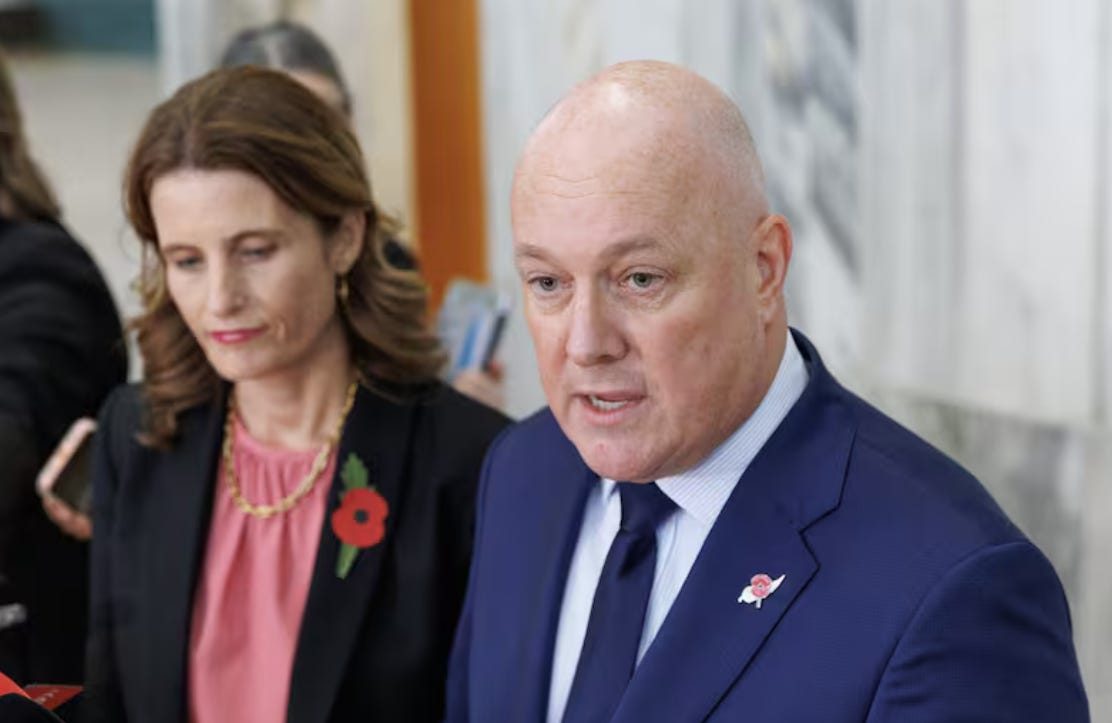
Another week, another round of speculation on the leadership of the National Party. As I write, the latest iteration has been put to bed with Christopher Luxon calling a vote on his leadership and winning.
As the title of this Substack suggests, I fear this rinse and repeat situation is not simply because of National’s current leader, but because this same dynamic has been playing out for years.
As I will try and lay out, there are cultural and structural problems within National (and equally true of other parties) that has led to mischievous opportunities currently being exploited, as various members of caucus leak and brief against colleagues. I suggest that until the usual suspects and troublemakers ‘win’ or are forced out, then what we have seen played out over recent months and days will not stop happening.
Other writers such as Liam Hehir and Ani O’Brien have written much about the Prime Minister’s performance, but I am not going to add to this ‘forensic’ analysis. Instead, I will suggest that there are key cultural and structural problems within the National Party that explain what is happening and that until these are resolved, leadership speculation and undermining – no matter who the leader is – will continue.
I would also suggest these problems are also at play in other political parties – it is not something unique to the right of politics, or even the political landscape of New Zealand.
Readers do not need me to tell them that National has had substantial internal problems since the John Key days. It is tempting to suggest that only since then that things have been unstable, but I would argue that the instability started during this time, if not before. It was never a case of the wheels falling off once John Key and then Bill English left. Instead, the nuts (no pun intended) holding the wheels on had already been loosened.
Much comes down to the nature of MMP, which puts enormous power into the hands of one person – the party leader. Most members of parliament rely on the patronage of the leader to get promotions, better list rankings, and so on. It also depowers the party itself, often making it secondary to the wishes of the political leader of the day. This in turns leads to a sycophantic culture, and one not adept at critique and consideration, or nuance. Consequently, during the Key years, the way the National Party operated began to change. People who would later go on to cause harm, chaos, and disgrace were promoted and given patronage during this time. Ministers bought in their friends to staff their offices and the offices of others, and then promoted these people’s ambitions to become MPs.
None of this is wrong per se, and nor does it apply to every case, but it does begin to explain the dynamics now playing out disastrously in public.
A party that once had a rather diverse range of characters and careers, has narrowed. One need only count the number of MPs – on all sides of the House – who are former staffers in parliament or union advocates, with little or any experience beyond this. There are interconnections and allegiances in place early on, with a commitment to persons rather than principles and policy.
Those not interested in patronage or sycophancy do not progress, leave of their own accord, or are pushed out to make way for those more accommodating. This is true of all political parties whether on the left or right of New Zealand politics.
We are also seeing what I would term weak selections. I don’t mean necessarily the individuals, but rather a selection process which sees seats barely contested. Over the years we have seen just one candidate for strong ‘red’ or ‘blue’ seats, or in others, only one or two candidates with often a pre-determined result.
At the heart of this cultural problem are MPs manoeuvering to get those aligned to them into parliament to support their personal ambitions. There is also an issue with fewer people joining political parties and consequently a narrowing of who is making decisions at a party level. Add to this the party list, which allows leaders to parachute in people of their choosing. Even further, you can even look at the electorate level where Luxon was affirmed on the backward-looking hope that they could find a quick and simple way to re-find the ‘magic’ of John Key.
Now, none of this should surprise anyone. Politics is a game, and these plays are precisely what someone with ambition would and should do. But I am suggesting it is precisely why there is trouble – as MPs bring in their mates to staff offices, collect intel from said offices, leak, undermine colleagues, stir foment, and brief the media.
You don’t have to agree with me, but you can see what is happening in National currently. Go wider and look at the Liberals in Australia or the Conservatives in the UK. It’s the same ambitious dynamic in play, with the same disastrous results.
We also need to appreciate the very real psychological and political nature of MPs. While I respect commentators who say politicians need to act more rationally, objectively, and so forth – I say, yes, that would be great, but you are asking leopards to change their spots.
MPs do live in a bubble. They do pour over polls; fret over the commentary in print, radio, or television; watch who has the leader’s ear and who does not; race about corridors whispering concerns to colleagues; are hurt when not promoted and still not satisfied when they are; notice the smallest of nods or scowls that indicate favour or not; and indulge in self-fulfilling prophecies by ruminating over the very things that will lead to the very trouble they should be avoiding.
I have been there, many times, when colleagues lose their nerve and rationality around polls, speculation, and rumour. When the intensity of the political bubble is such that clear vision disappears and that self-fulfilling inevitably of panic sets in, it is the equivalent of yelling “fire” in the cinema even if there is no fire.
We also need to understand that MPs have a range of motivations. Whether on the left or right, those who have leadership ambitions will do anything to get ahead. This is not particularly new information, but each of us should always question why the media are choosing to mention and promote certain people, or ask who is advantaged by the latest leak, or puff piece about them.
There are also those MPs who, to use a card-playing analogy, are more than happy to throw the entire deck into the air and hope the cards fall better this time. This may not seem rationale or sensible, but it is true. There also are MPs who are simply vindictive, happy to undermine anyone who holds a role they covet.
So while it is easy for some to tritely say that MPs need to pull their heads in and put the party and country first, it fails to ignore the deep personal drivers for many in political life.
Problematically for National, there remains a small cadre of extremely ambitious individuals who have been at the heart of every coup and instability. Their ability to continue operating points to the very cultural and structural issues I have noted.
Until they either win and gain the power they seek, or are removed from influence, then nothing will change. Until then, it is rinse and repeat.
This article was originally published by On Point.