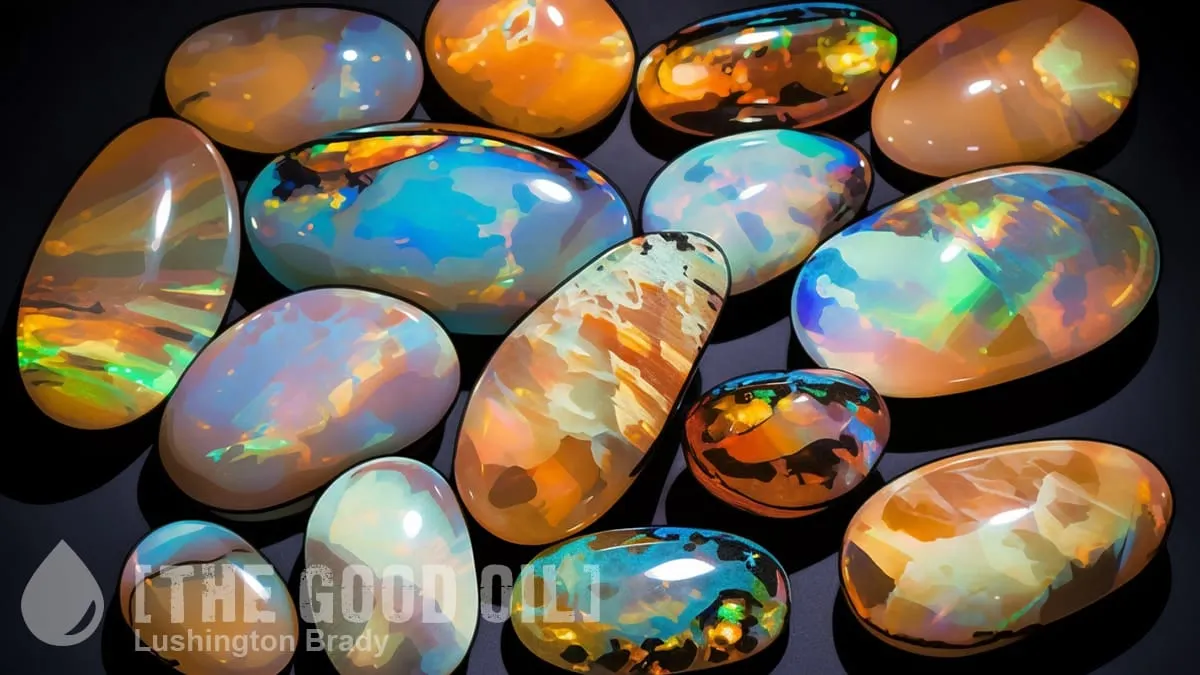
Most people see a pretty stone that catches the light in a jeweller’s window. What they’re actually looking at is a geological accident so slow and so improbable it makes the trilobite look almost contemporary. Five million years to grow a single centimetre. Modern humans have been upright for roughly 300,000 years. The opal on someone’s finger has been quietly assembling itself for 16 times longer than that.
Most people look at an opal and see a pretty stone. What they’re actually looking at is a frozen accident of time so improbable it borders on impossible.
Five million years for one centimeter. Read that again slowly. The opal sitting in a ring on someone’s finger represents a span of geological patience that predates the entire human species. Modern humans have existed for roughly 300,000 years. The little gem catching light on a jeweler’s velvet cushion has been quietly assembling itself for 16 times longer than we’ve walked upright.
Unlike every other classic gem – diamond, ruby, sapphire, emerald – the opal is not a crystal. It has no rigid lattice of atoms repeating in tidy geometric order. It is a mineraloid, an amorphous solid more closely related to glass than to anything that can be cleaved along neat planes. Under the microscope it is nothing but countless microscopic spheres of silica stacked like the tiniest, most astonishingly beautiful bubble pit.
When those spheres are uniform in size and packed with amazing regularity, the gaps act as a natural diffraction grid, splitting white light into its component colours and flinging them back at the eye. The size of the spheres is what determines the colours: smaller spheres give blues and violets, larger ones produce the rare, expensive reds and oranges.
The colour in an opal is not pigment. There is no red dye, no green mineral, no blue compound. The stone is essentially colorless silica and water. Every flash of fire you see is pure structure, pure geometry.
You are watching physics, not chemistry.
And then there’s the water. Opals contain six to 10 per cent of the stuff, ancient groundwater sealed inside during formation.
That six to 10 per cent water content is doing something almost no other gemstone does. It means opal is partly liquid history.
It also means that opals can die. That water is part of their structure. Remove an opal from a humid environment and put it somewhere bone-dry for long enough and the water slowly leaves. The stone crazes, the play of colour fades and the thing effectively dies. Diamonds are forever; an opal can dehydrate and pass away.
The formation process itself is a kind of patient vandalism. Silica-rich water seeps into cracks and voids in rock, evaporates, and deposits its load layer by microscopic layer over those absurd timescales. Like something from the Tao Te Ching, an opal is the fossil of an absence: the cast of a gap left in the earth by something else, slowly filled and turned into the most colourful substance the planet produces. In parts of Australia the process has seen the opal has replace dinosaur bones, seashells, teeth and even pinecones. In one of the most jaw-dropping cases, an entire pliosaur (a genus of carnivorous marine reptiles with massive heads, short necks and streamlined bodies that swam using four big fins) was partially opalised.
So, the next time you see some trinket set with an opal, pause to reflect and show a bit of respect.