Yvonne van Dongen
Veteran NZ journo incredulous gender ideology escaped the lab. Won’t rest until reality makes a comeback.
Pity the poor young transvestite.
Having looksmaxxed make-up, porny pouts, fake boobs and nifty genital tucking (few opt for surgical removal) – it appears love eludes him.
I say this since a young Auckland friend (he’s 30) showed me the kind of women who appear on his dating app profile. He had been complaining that there were so few decent women online nowadays. I found this hard to believe and thought he must be too picky (very likely given that much online dating feels like a shopified, commodified horror chamber). In his defence, he opened up his Hinge feed and showed me what was on offer.
Once we’d swiped past the women deemed of no interest to such a discerning client (too plain, too fat, too young and, most common criticism of all, too pornified), there were few suitable women left. Of those that were left, many weren’t even women.
The number of ‘trans women’ popping up on his feed was astonishing, so astonishing that my friend was prompted to check his filters. Nope, there it was – the box stating interested in male, female, non-binary or other. He’d only ticked ‘interested in women’. Not men, not non-binary, not even other.
Despite this, we estimated that about one in five applicants on his feed were men pretending to be women. Twenty per cent! One can only assume that Hinge believes trans women are women – and thinks men should too.
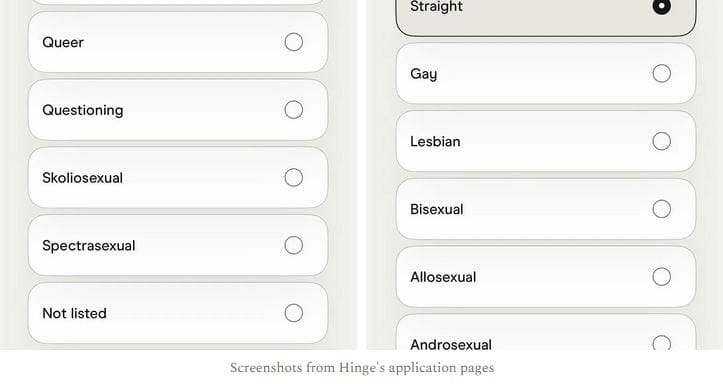
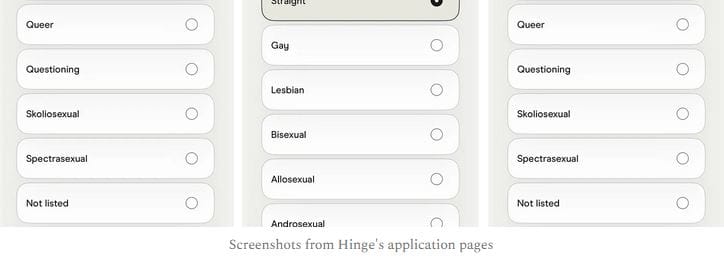
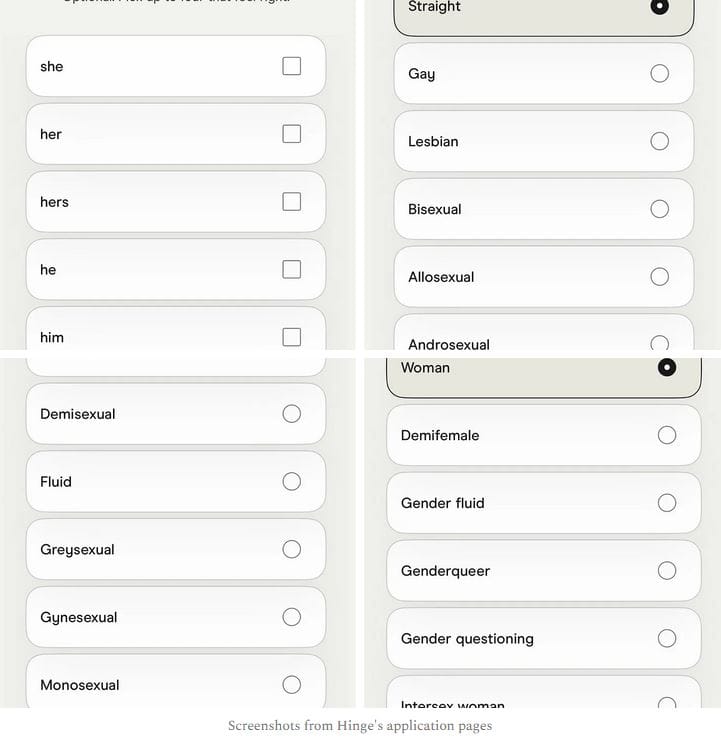
One look at the filters and it’s easy to see that Hinge has gone full woke. It asks ‘what are your pronouns’, also ‘what’s your sexuality’ and offers about a dozen possibilities. Same with ‘what gender best describes you?’ Greysexual anyone? Or maybe just bicurious or flirting with androsexuality? I have no idea what any of that means either. See pix below.
The transvestites all outed themselves as trans women and many looked to be of Asian heritage. Their over-representation on my friend’s feed may be due to the social conservatism of Asian culture. It may be that in some communities it is more acceptable to appear as a straight couple than as a gay couple.
The other notable change my friend remarked on was the number of women who responded to him, that he’d never ‘liked’ before. He wondered if the algorithm was falsely encouraging them with phoney ‘likes.’ He concluded this was likely to be a strategy adopted by Hinge. Stats show women are leaving online dating apps in droves so to keep them interested Hinge may be passing on false likes. He also concluded that keeping people on the app was really their aim, despite claims of wanting people to delete because they’ve found someone. This might incentivise the app to hold back the ‘hotties’.
In any event, he found the whole experience so dispiriting, he has since deleted all his dating apps and sworn off them for good. He tells me he’s back to looking for love in the wild.
Research shows he is in good company. Dating app burnout is real. Over time users report emotional exhaustion and inefficacy. You only have to track the share price of Match Group Inc, the company that introduced many of these apps, to see it’s a model that is going out of fashion.
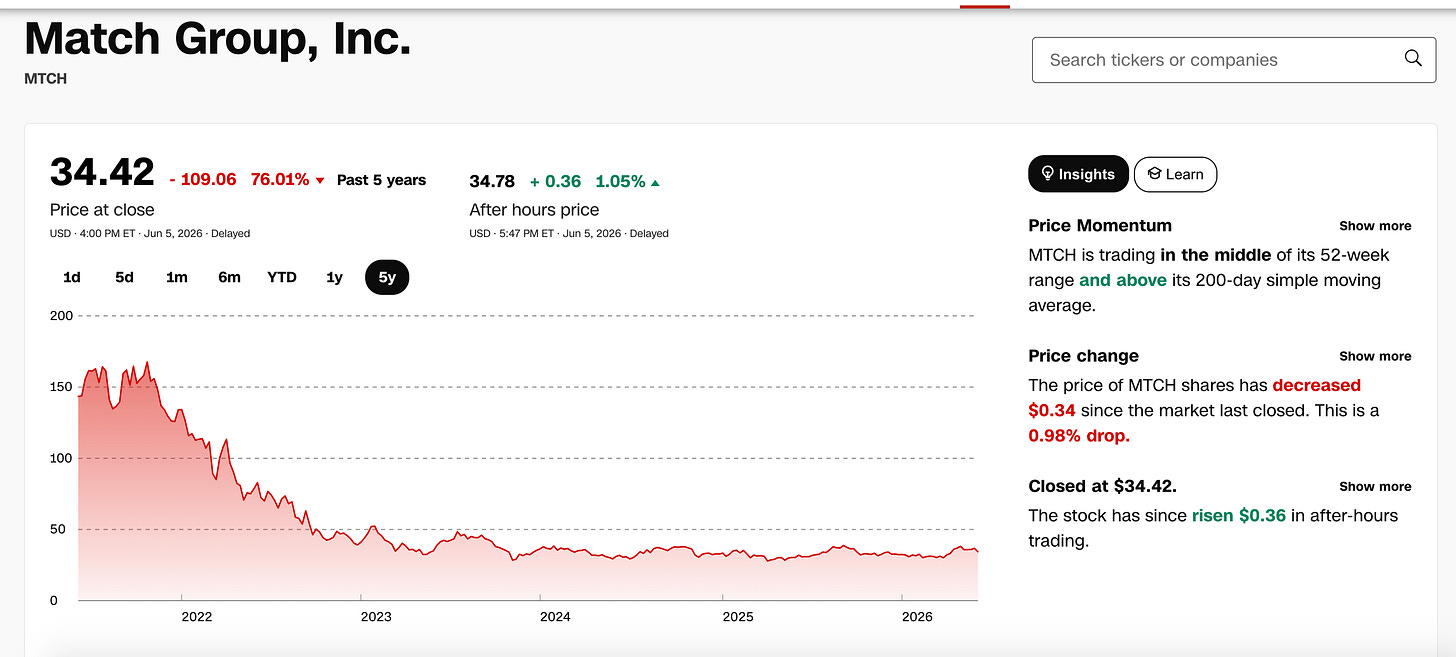
Although my friend found the dating app experience and the over-representation of transvestites disheartening, I was secretly pleased. Pleased that the ‘go woke, go broke’ maxim appeared to be holding true and pleased that my friend was opting for the real world, as opposed to the synthetic experience of digital dating.
For all the public angsting about the evils of social media (and they’re real), it’s interesting to see the evolution of the dating app going from acceptable to annoying, from desirable to depressing amongst its native users.
We may also have the transgender movement to thank for the restoration of free speech thanks to Elon Musk’s purchase of twitter, now X.
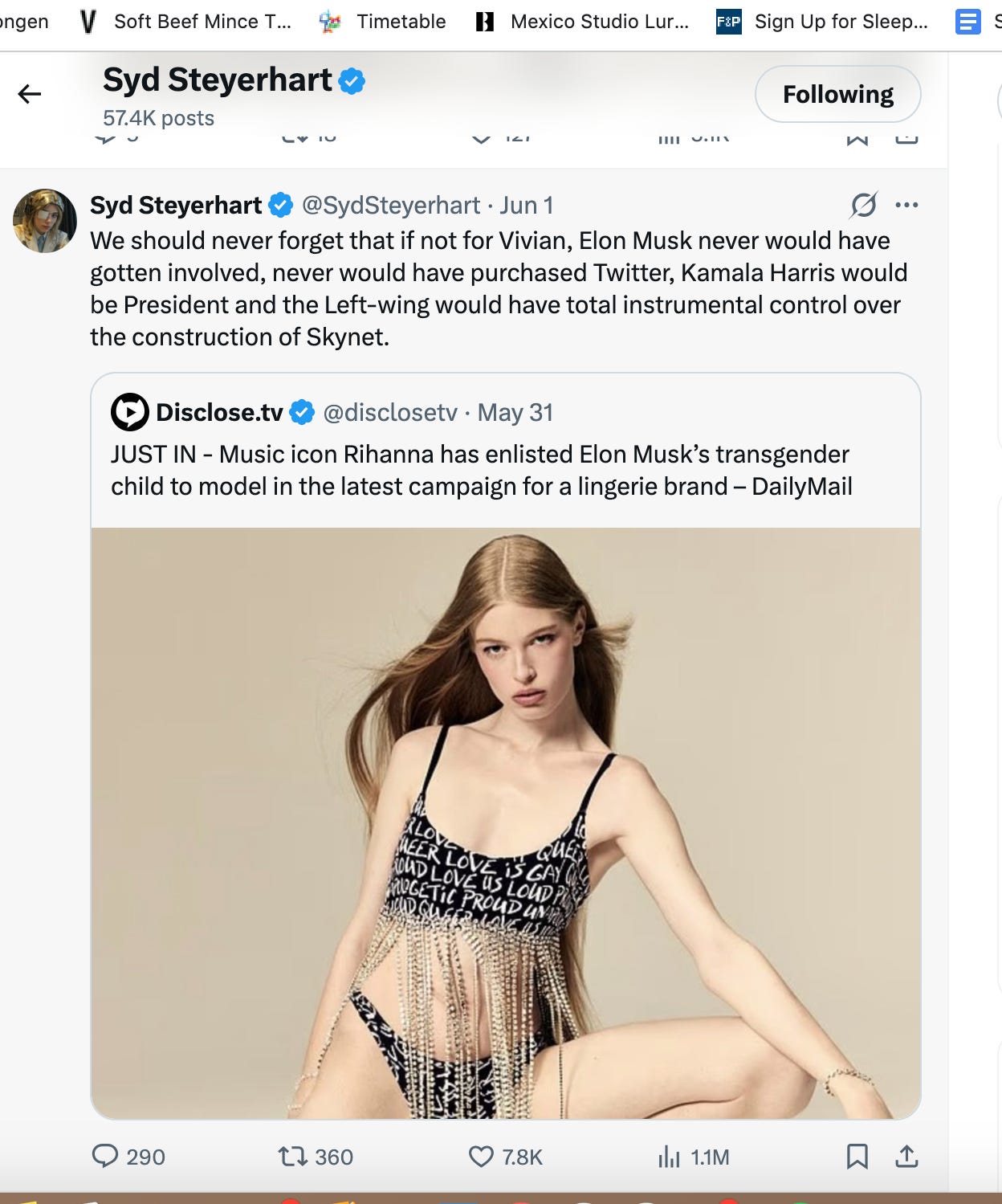
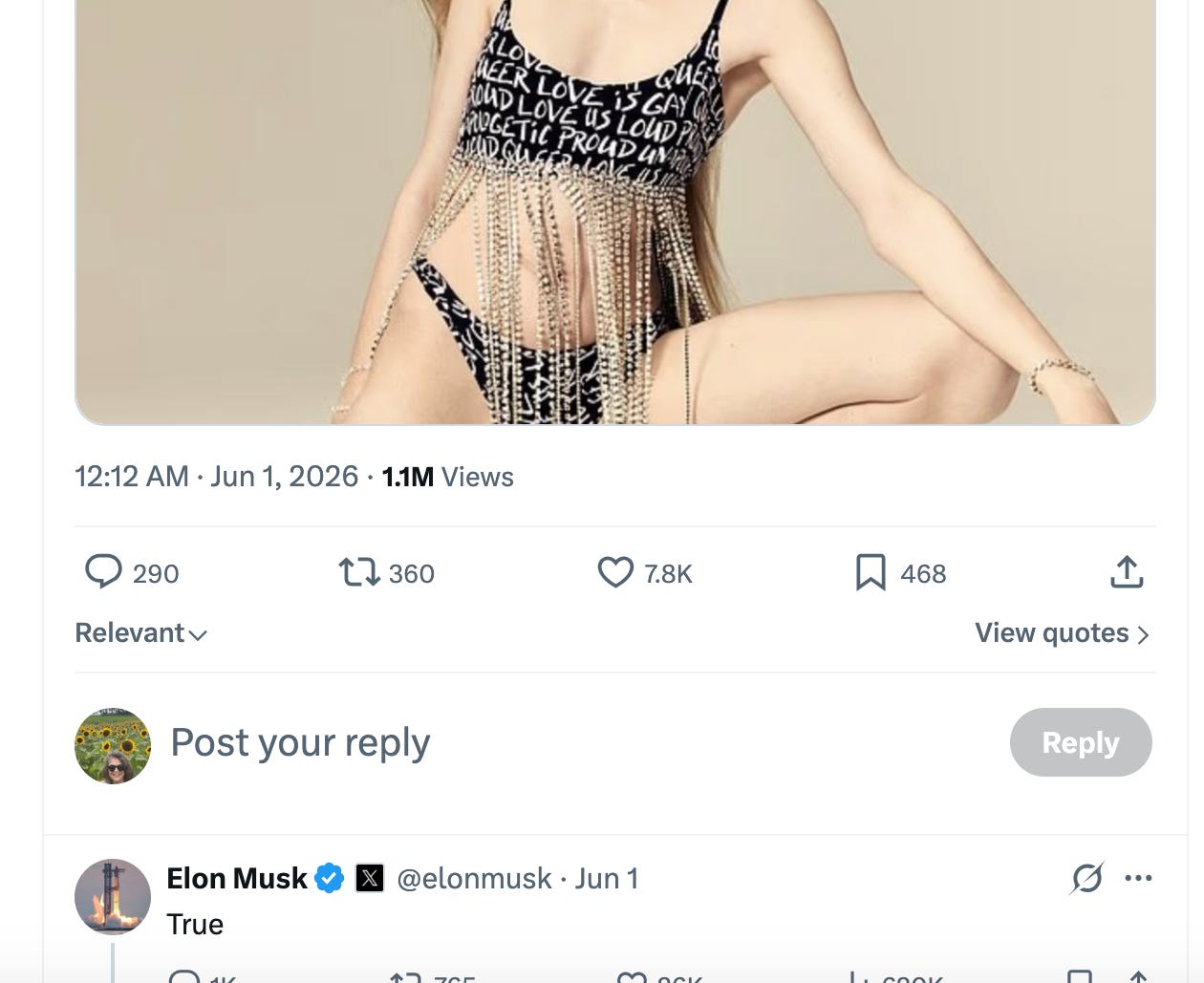
Just over a week ago a user posted (quoting a Disclose.tv item about Vivian Jenna Wilson modelling for Rihanna’s Savage X Fenty Pride campaign):
“We should never forget that if not for Vivian, Elon Musk never would have gotten involved, never would have purchased Twitter, Kamala Harris would be President and the Left-wing would have total instrumental control over the construction of Skynet.”
Elon replied directly with “True.”
PI
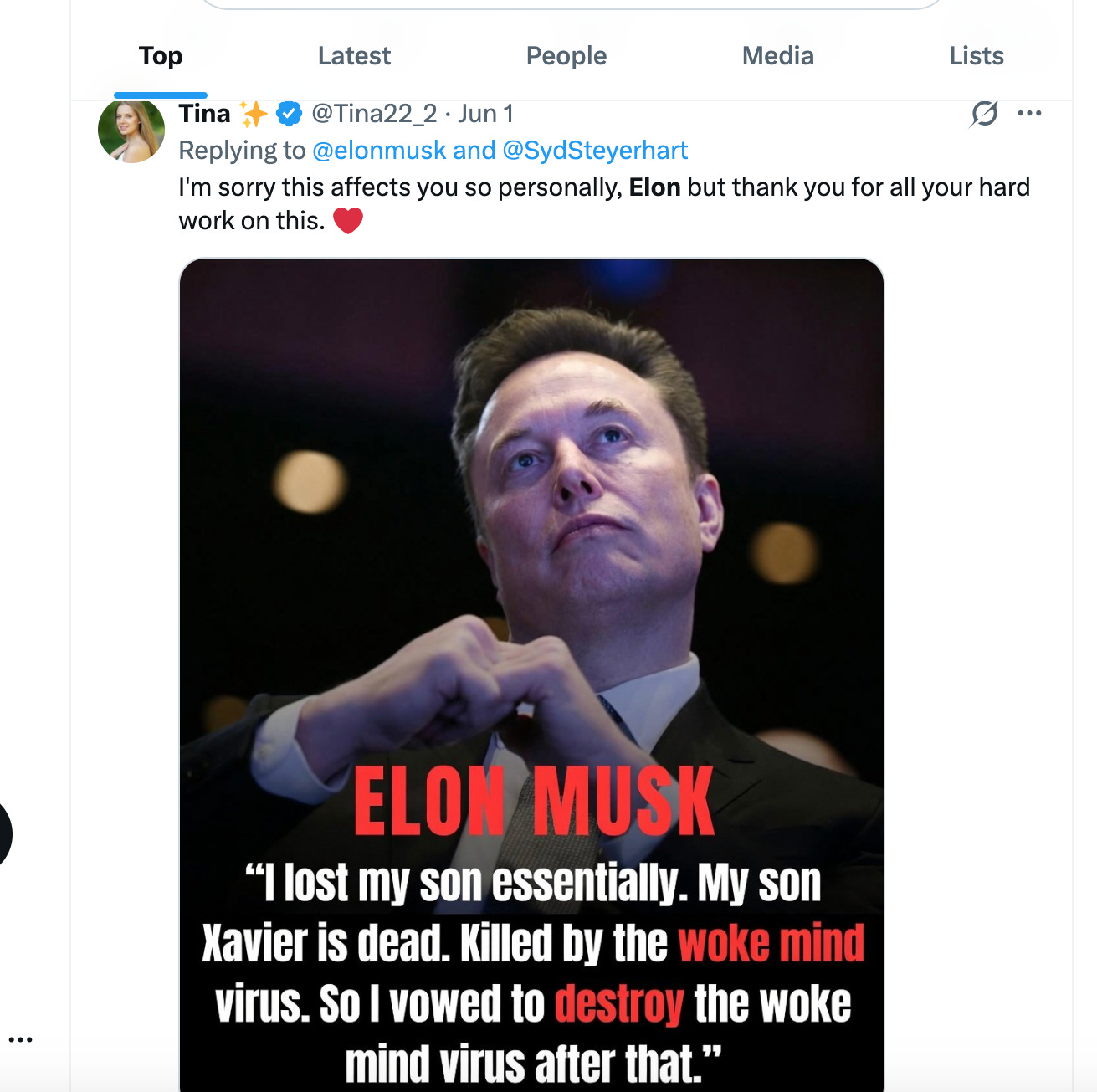
In March 2022, Twitter suspended the Babylon Bee, a satire account, for posting a headline naming US Assistant Secretary for Health Admiral Rachel Levine – a man posing as a woman – its “Man of the Year.” Babylon Bee CEO Seth Dillon confirmed that Musk called him directly to verify the suspension and “even mused on that call that he might need to buy Twitter.”
Not long afterwards, text messages show his ex-wife Talulah Riley texting him:
“Can you buy Twitter and then delete it, please!? America is going INSANE. The Babylon Bee got suspension is crazy.”
Riley went further:
“Or can you buy Twitter and make it radically free-speech? I honestly think social media is the scourge of modern life… But it’s very easy to exploit and is being used by radicals for social engineering on a massive scale. And this shit is infecting the world. Please do do something to fight woke-ism. I will do anything to help!”
Musk replied:
“Maybe buy it and change it to properly support free speech.”
Just weeks later, he made his $44 billion offer to buy the company outright.
Trans-activists complain that post-Musk the platform has become hostile to them and their cause. For instance, Musk removed Twitter’s longstanding policy banning the deliberate ‘misgendering’ and ‘dead-naming’ of transgender users, rules that had been in place since 2018. Most TRAs have fled to other apps such as Bluesky.
The purchase came at a cost. Even though X has stopped the steep post-acquisition revenue free fall, it’s a much smaller business now than it was in 2021–2022. It is also still heavily indebted, and reliant on Musk’s ecosystem for long-term viability.
What to make of all this? The way I see it, social media is neither an unalloyed evil, nor an undiluted good. It both giveth and taketh away. We humans are still learning how to handle this powerful new technology that has driven us all half mad. But glimpses revealing cracks in the machine give me reason to hope that we can save the other half.
This article was originally published on the author’s Substack.