When it comes to legacy media science ‘reporting’, especially when it comes to ‘climate science’, the agenda bellows while the truth whispers. When it’s not being smothered entirely.
Case in point: the 2012 Gergis et al paper, which claimed the hottest 60-year-span in 1,000 years, was greeted with trumpets, euphoniums and wall-to-wall coverage by the legacy media. Few louder and more sustained than the ABC.
Then the paper was retracted by the publishing journal, after a humble blogger pointed out that it was riddled with errors. The authors lied that they had voluntarily put it ‘on hold’. The legacy media said nothing at all. Yet, they have continued to platform Joelle Gergis, including, with not a blush of irony, on a podcast on how to ‘cut through spin’. You couldn’t make this stuff up.
But, when it comes to ‘climate science’, making stuff up is a feature, not a bug.
The latest example, and yet another example of the legacy media bellowing bollocks when it suits their agenda but being struck dumb when genuinely inconvenient truths emerge, is the supposed ‘death of the Great Barrier Reef’, which, like Mark Twain’s, turns out to have been greatly exaggerated.
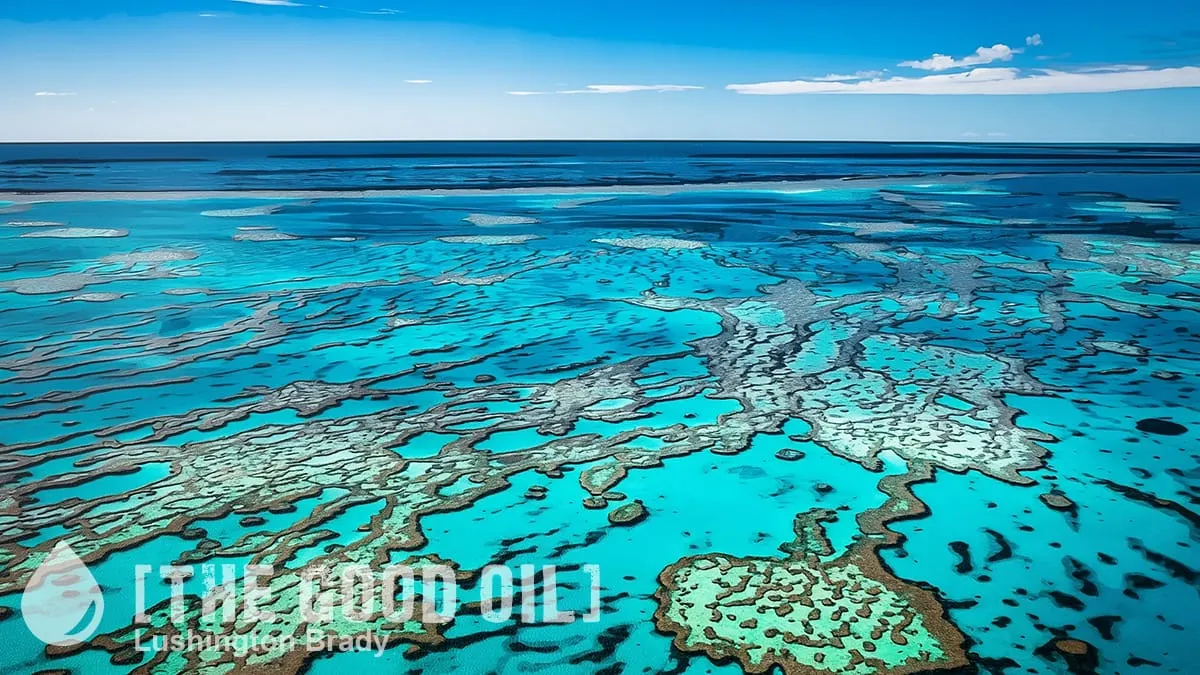
Despite decades of scientific consensus that it is facing a catastrophic climate change triggered demise, the Great Barrier Reef is refusing to die.
The latest results from the Australian Institution of Marine Science shows that coral cover on the reef has bounced back from mass bleaching in 2025 and early 2026 and remains at near record levels across its 2300km length from Cape York to Bundaberg.
The AIMS long-term monitoring program confirms the GBR maintains its resilience and ability to recover from disturbance, saying coral cover across all three regions of the reef, the northern, central and southern GBR, increased slightly or remained at similar levels to those recorded last year.
Marine physicist Peter Ridd notes that for all of the past five years the raw cover has been higher than in any of the previous 35 years. Five bleaching events since 2016 produced no major drop. Those time spans may seem short, and they are, but it’s important to remember that when climate scientists solemnly intone doom-laden phrases such as ‘the hottest on record’, they are almost invariably talking about a century or less of instrumental data. Geological time is inconveniently long – thermometers are not. More pertinently, 35 years is well within the ambit of a ‘climate cycle’.
Dr Ridd said the AIMS data showed that the major cause of temporary coral loss over the decades had been from cyclones and crown of thorns starfish plagues, both of which were entirely natural. “There is no evidence that these are any worse than in the distant past,” he said.
Yet the ritual lamentations continue. AIMS itself still insists climate change remains the greatest threat, while papers in Nature and Nature Communications pronounce existential doom with the usual certainty. Greenpeace, never ones to let data spoil a good panic, declared the reef “still in deep danger from runaway climate heating” after UNESCO declined to list it as World Heritage “in danger”.
Commonsense, that unfashionable commodity, has long suggested otherwise. The Great Barrier Reef is at least 500,000 years old and some sections date back 20 million years. It has endured ice ages, interglacials, sea-level swings of a hundred metres and temperature regimes far more extreme than anything the last century has thrown at it. The notion that this ancient, dynamic system is suddenly on the brink of extinction because of a few tenths of a degree of warming always required a heroic suspension of disbelief.
Dr Ridd said recent bleaching events had killed very little coral, and that the institutions had been exaggerating the impact of those events.
That isn’t going to win Ridd any institutional friends, of course, but then, that ship sailed long ago. Ridd remains the most conspicuous casualty of the bandwagon-circling that protects the official reef narrative. He was sacked from James Cook University, not because his science was shown to be wrong but because he criticised his fellow scientists too openly (“courtesy and collegiality” was the anodyne official phrase) and refused to pretend the data said what the funding bodies preferred. The institutions circled the wagons and the media largely looked the other way. Truth, once again, was expected to whisper while the agenda bellowed.
The latest AIMS numbers are simply the latest inconvenient fact. Coral cover fluctuates. It always has. Recovery after disturbance is normal, not miraculous. The reef is robust. The narrative is not. And the silence that greets good news about the Great Barrier Reef is as telling as the hysteria that greets every bleaching event.