Table of Contents
Judy Gill
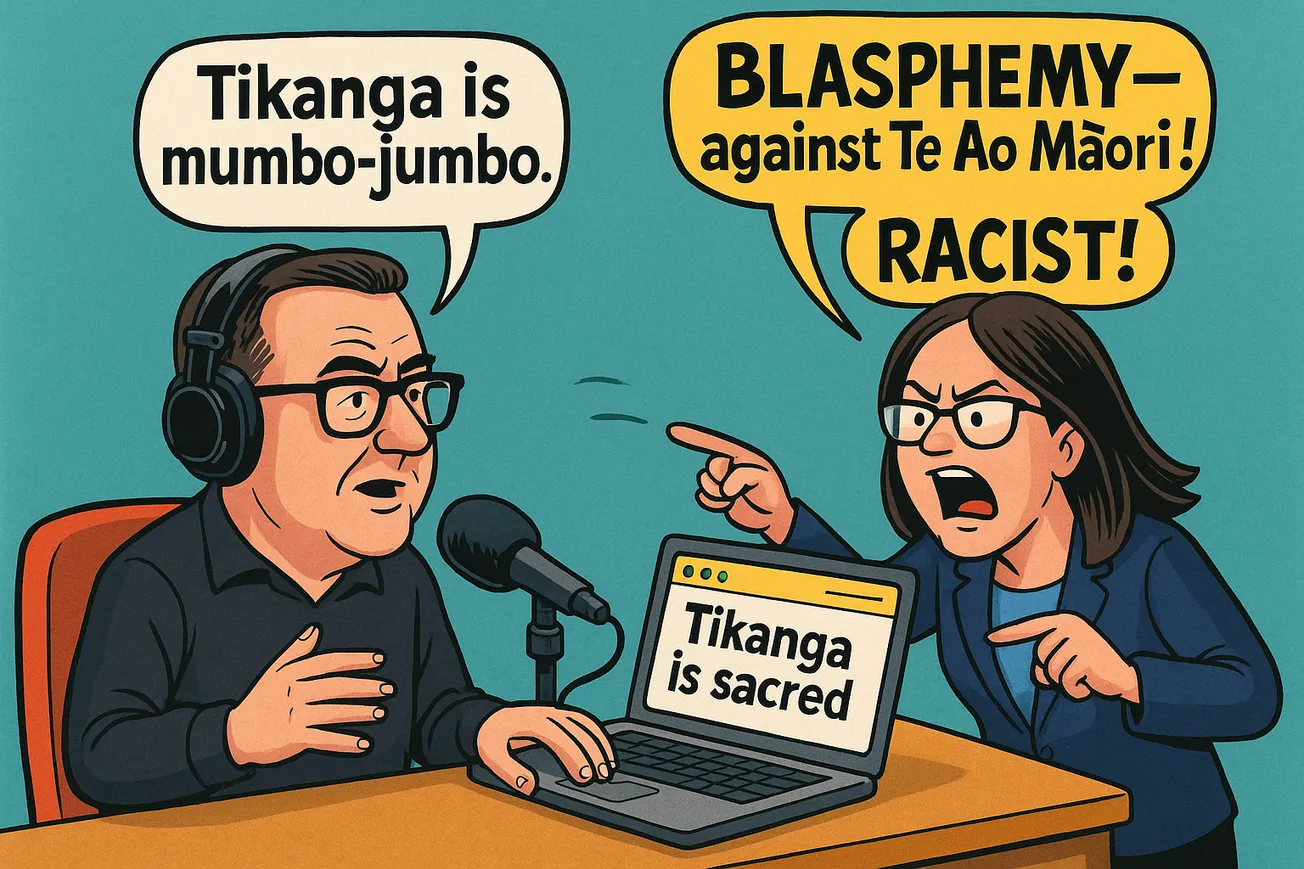
“Tikanga is mumbo-jumbo.”
That simple statement – a personal opinion about a belief system – is now being treated as religious blasphemy and an expression of racism in Aotearoa New Zealand.
The Broadcasting Standards Authority (BSA), which was created to regulate television and radio broadcasting, announced that it wants to investigate broadcaster Sean Plunket over remarks made online – even though his programme, The Platform, operates entirely on the internet and therefore falls outside the BSA’s statutory jurisdiction.
So what is the alleged offence? Not defamation – but racism and religious sacrilege.
The implication is that tikanga Māori (often described as ‘the correct way of doing things’) is now considered sacred and beyond public criticism. To describe it as superstition or mumbo-jumbo is apparently to insult something holy.
From free speech to blasphemy law
New Zealand repealed its blasphemy law in 2019. Section 123 of the Crimes Act 1961 – “blasphemous libel” was formally removed by parliament.
Yet here we are, 60 years later, watching an unelected regulatory body attempt to recreate the same offence through the back door.
Under the BSA’s discrimination and denigration code, it is a breach to encourage hostility toward a group based on their religious beliefs.
But that clause is now being stretched to cover criticism of mātauranga Māori, tikanga and Te Ao Māori spirituality – systems that are explicitly spiritual and theological, not merely cultural.
In effect, the BSA is positioning itself as a guardian of sacred doctrine.
It no longer protects viewers from offensive broadcasting: it protects a state-endorsed faith from blasphemy.
A new state religion
Across at least 50 statutes, government agencies are embedding Te Ao Māori spirituality into public policy, education and law. Concepts such as wairua, mana, mauri and tapu are invoked as guiding principles – not metaphorically, but spiritually.
What was once a neolithic belief system is now becoming a civil religion, administered through public-service codes, school curricula and official ceremonies.
If the BSA succeeds in treating criticism of those ideas as hate speech or denigration, then New Zealand will have effectively re-introduced blasphemy law – only this time in service of te ao Māori fundamentalism rather than Christianity.
Freedom means the right to disagree
Freedom of religion includes the freedom not to believe.
Freedom of expression includes the freedom to criticise belief.
And equality before the law means that no faith – old or new – is above scrutiny.
Calling tikanga “mumbo-jumbo” may offend believers, but offence is not a crime.
The attempt to treat it as one is far more dangerous to democracy than any remark ever made by a broadcaster.
New Zealand’s real free-speech exceptions
LEGAL LIMITS
1. Hate-Speech and Incitement Laws – Human Rights Act 1993 (s61 & s131): illegal to incite hostility or contempt toward groups by race or ethnicity (government has floated expanding this to religion, gender and more).
2. Harmful Digital Communications Act 2015 – criminalises online posts causing serious emotional distress.
3. Defamation Law – civil suits for damaging someone’s reputation.
4. Contempt of Court/Suppression Orders – speech that prejudices a trial or breaches suppression can lead to prosecution.
5. Privacy and Confidentiality Rules – publishing private data or leaked documents can breach the Privacy Act 2020.
6. Employment Codes of Conduct – speech ‘bringing an employer into disrepute’ can mean job loss, especially in public service or education.
7. Broadcasting and Advertising Standards – the BSA and ASA restrict material deemed offensive or denigrating to a group.
CULTURAL & SOCIAL TABOOS
8. Cultural Blasphemy’ – criticising Te Ao Māori spirituality or political sacredness risks being labelled racist or hateful.
9. Academic and Institutional Codes – universities and ministries enforce ‘Tiriti obligations’ that chill dissent.
10. Social-Media Moderation/De-platforming – posts critical of state-endorsed culture or ‘disinformation’ are routinely removed.
Free Speech in NZ: Legally limited → Socially punished → Politically discouraged.
You may have the right to speak – but not the right to be heard.
Conclusion
If the Broadcasting Standards Authority wishes to act as New Zealand’s new inquisition, it must first obtain a ruling by the High Court of New Zealand or from parliament and the people.
Until then, its moral policing has no lawful authority and no place in a free country.