Table of Contents
Extinction is a big thing in Tasmania, with humans always framed as the villains. But the brute fact of nature is that extinction is the rule: climatic shift, geologic processes and species migration make nature truly red in tooth and claw. By the 19th century, Tasmania, a tiny ecology, had been isolated from the world for more than 10,000 years. That isolation had to end, sooner or later, and many species that had been clinging on in splendid isolation in Tasmania were inevitably going to be thrown back in to the red-in-tooth-and-claw battle against extinction. Isolated as they were, many were singularly unequipped to resist.
Much fuss was by the nascent green movement over the presumed fate of the Lake Pedder galaxias, a kind of glorified minnow, when that lake was joined to the rest of the state’s waterways by a dam project. But Lake Pedder was, geologically speaking, a transient phenomenon, formed when the rubble from receding glaciers blocked an ancient river valley. Sooner or later, though, the moraine that held up the lake was going to give. The Lake Pedder dam project just made it sooner.
(As it happens, the Lake Pedder galaxias is thriving today, thanks to human intervention. Can we get a round of applause for humanity, misanthropic greens?)
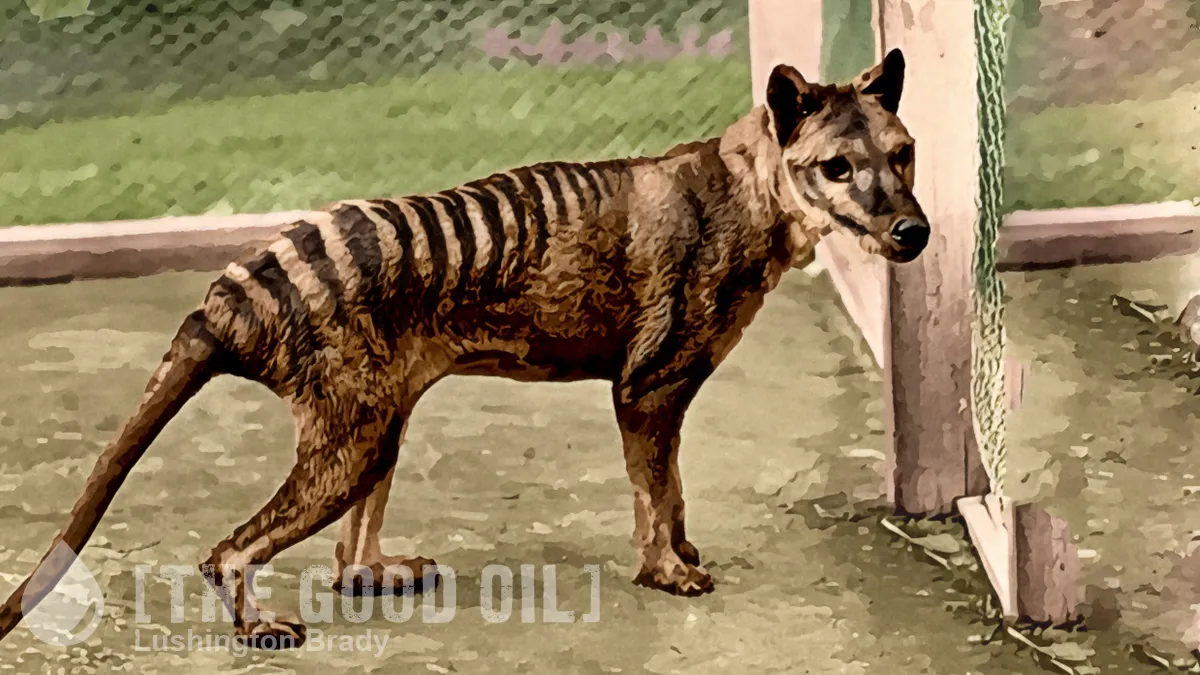
The thylacine, the famous Tasmanian Tiger, was clinging on every bit as much as the Lake Pedder galaxias. Its toehold on life was so threadbare that, even before European settlers realised the species was in strife, the die was set. By the time protections were put in place, it was already too late.
It’s almost universally accepted to blame the extinction of the thylacine on European settlement. There’s no doubt that European hunting, especially with a bounty placed on the creatures’ heads, was the last blow that knocked them off their perch – but how wobbly was that perch in the first place? As new research suggests, very wobbly indeed.
The thylacine once ranged as far afield as New Guinea. It disappeared from there about 3600 years ago and went extinct on the Australian mainland about 2000 years ago. Hunting by Aborigines, who’d already wiped out the Australian megafauna almost immediately after arriving on the continent, was probably a major knock. The killing blow was almost certainly the arrival of dogs, in the form of the dingo, about 3000 years ago. The poor thylacine just couldn’t compete.
But the new genetic research suggests that the thylacine’s ultimate fate was set in motion as much as six million years ago.
Nagarjun Vijay and Buddhabhushan Girish Salve at the Indian Institute of Science Education and Research Bhopal first became interested in the genome of the Tasmanian tiger while studying the genome of the Bengal tiger (Panthera tigris tigris).
“We were seeing some parallels between the extinction of the thylacine with our own tiger,” says Vijay. “And there is a lot of impetus to conserve the tiger in India.”
Like the Tasmanian devil today, or the African cheetah, evolutionary bottlenecks slimmed down the genetic diversity of both Bengal tigers and Tasmanian tigers.
The pair suspected that hypercarnivores like the Bengal tiger and the Tasmanian tiger have, through their evolutionary history, lost genes that may leave them vulnerable when exposed to environmental changes or new diseases.
They analysed genetic records previously recovered from thylacine museum specimens and compared them with the genome of their close relative, the Tasmanian devil (Sarcophilus harrisii), and other marsupials.
In contrast to almost every other marsupial, including Tasmanian devils, thylacines had lost at least four important genes, known as SAMD9L, HSD17B13, CUZD1 and VWA7 […]
The loss of these genes might have had advantages under certain conditions in the past, but it potentially compromised the species’ health by reducing antiviral defences, metabolic processes, lactation and their susceptibility to cancer and pancreatitis, Vijay and Salve suggest.
It’s natural to assume that such a loss of genetic diversity came about as a result of a small population living in total isolation (yeah, yeah, I know all the Tasmania jokes). Surprisingly, this doesn’t appear to be the case.
Thylacines lost SAMD9L, CUZD1 and VWA7 at least six million years ago at a time of massive climate change – a period that saw the species increase dramatically in size and become a hypercarnivore, subsisting almost entirely on meat.
“The overall narrative has always been that it is mostly human intervention, or anthropogenic changes, that have had an effect on the extinction of thylacines,” Vijay says. “And we were thinking, maybe we will see some genes that were lost that are linked to disease and that is what we found.”
Timothy Churchill at the University of New South Wales, Sydney, says there is no doubt that climatic changes in Australia over millions of years before humans arrived led to a dramatic loss of thylacines’ genetic diversity. He says it is also possible that the gene losses reported in the new study could have made Tasmanian tigers more susceptible to disease, but confirming this would require much more research.
As Churchill says, such species have backed themselves into an evolutionary corner and are able to eke out survival in an isolated niche for a long time. But when the isolation ends, the jig is up.
It was likely dingoes wot done ’em in, on the Mainland, and European humans in Tasmania.
Oddly, not a green alive would pour scorn on the dingo, though.





![[The Good Oil] Stuff Up of the Day](/content/images/size/w1304/format/webp/2024/09/Stuff-up-image-1.webp)