Part 2: Did Labour’s pivotal teen vaccine meeting happen? One agency says no. Another says yes and names everyone there.
Editor’s note: This is the second of a three-part Centrist investigation into teen COVID vaccination and myocarditis-related communications in August 2021. The report draws largely on documents obtained via OIA requests by researchers Aly Cook and Sue Grey.
Part one asks why potentially relevant information about myocarditis was removed from public communications and whether the reasoning was scientific or political.
Part two asks why there is no reliable internal account of the Vaccine Ministers meeting at the centre of the decision sequence.
Part three asks why much of New Zealand’s media has largely declined to investigate either question.
In brief
- The Ministry of Health says a consequential Vaccine Ministers meeting, in August 2021, involving Jacinda Ardern, Chris Hipkins, and senior health officials, took place days before Cabinet approved Pfizer for 12 to 15-year-olds.
- The big issues at the time were how many doses young people should receive, the interval between them, how myocarditis risk should be managed and what parents and teenagers would be told.
- DIA separately said the meeting described in another requester’s OIA did not take place, while DPMC identified and is refusing to disclose to the public a briefing prepared for Ardern ahead of what was at least an expected meeting.
- The Ministry’s detailed response is the more compelling account because it names the chair, ministers and officials present and is supported by contemporaneous emails referring to the scheduled meeting.
- But conflicting responses and missing records leave the decision process unclear.
Here’s what we know
The Ministry of Health (MoH) has formally confirmed that a key Vaccine Ministers meeting took place on August 13, 2021, as the government considered extending Pfizer vaccination to 12 to 15-year-olds.
It named the ministers and senior health officials present, but also said the meeting was not minuted and no notes exist.
The wider official record is contradictory.
The Department of Internal Affairs (DIA) told Nelson-based lawyer Sue Grey that the meeting described in her Official Information Act (OIA) request did not take place. The Department of the Prime Minister and Cabinet (DPMC) identified a briefing prepared for Jacinda Ardern ahead of the meeting, but withheld it in full. Tongue in cheek, DPMC’s position amounts to “if we told you, we’d have to kill you”.
The published ministerial diaries also fail to provide a clear and consistent account.
The Ministry of Health’s detailed response is the most compelling evidence about whether the meeting occurred, at least to Centrist. It names the chair, attendees, and officials, and is supported by contemporaneous emails that refer to it.
Assuming the meeting did occur, what remains unknown is what ministers discussed, what advice they considered and why they chose the policy and public messaging that followed. The public deserves to know whether those decisions were driven by the best medical advice or by a political desire to keep the vaccine message simple.
A critical (disputed) meeting
According to MoH, at 1.30 pm on Friday, 13 August 2021, New Zealand’s Vaccine Ministers met by Zoom.
This was not to be a routine operational meeting. Major policy decisions were to be weighed. Ministers were to consider whether to bring an entirely new age group into the national vaccination programme, what dosing schedule they should receive, how myocarditis risk should be managed, and what information parents and young people would be given.
Those decisions affected hundreds of thousands of families and went directly to safety, informed consent and public trust.
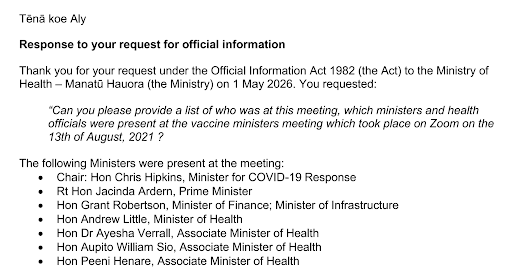
MoH says Chris Hipkins chaired the meeting. Jacinda Ardern attended, along with Grant Robertson, Andrew Little, Ayesha Verrall, Aupito William Sio and Peeni Henare.
Senior officials included Director-General of Health Ashley Bloomfield, representatives of the COVID-19 Directorate, the Vaccine Programme and Medsafe.
August 13th is just days before Cabinet approved Pfizer eligibility for 12 to 15-year-olds.
Contemporaneous correspondence suggests some sort of approval process took place. For instance:
- On 12 August, Town told CV TAG members that advice on vaccinating 12- to 15-year-olds would be considered by Cabinet after discussion at the “regular Vaccine Ministers Zoom meeting” the following afternoon.
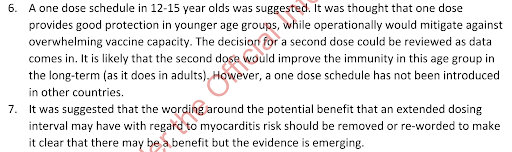
- He also said CV TAG’s myocarditis advice had been accepted by Bloomfield and communicated in detail to Vaccine Ministers.
- The following day, draft clinical bullet points covering youth vaccination, a possible one-dose schedule and myocarditis communications were prepared for Town.
- At 12.46 pm, Lead Science Advisor Fiona Callaghan emailed the bullet points to Town and said she would print them and place them on his desk.
- At 1.07 pm, Town forwarded them to Bloomfield.“Heading to moh [Ministry of Health] now,” he wrote.
The disputed Vaccine Ministers meeting was apparently at least supposed to be that afternoon at 1.30 pm, strongly suggesting the document was being carried into the decision process.
The emails do not prove that every bullet point was presented or debated at the meeting. They do, however, independently support the Ministry’s account that a regularly scheduled Vaccine Ministers meeting was due to occur that afternoon and that the relevant issues were moving towards senior decision-makers.
The Ministry confirms the meeting
Researcher Aly Cook asked the Ministry to identify those present and provide notes and correspondence relating to the meeting. In its 29 May 2026 response, the Ministry supplied a detailed attendance list but stated that the meeting was not minuted and that no notes exist. It refused the request for those records under section 18(g)(i) of the Official Information Act because the information was not held.
That response is more detailed and specific than the separate DIA response saying the meeting described in Sue Grey’s request did not take place. It identifies the date, time, chair, ministers and categories of officials present.
Why the departments appear to disagree
In a 5 May 2026 response to Grey, DIA said “the meeting you have requested about did not take place” and refused the request under section 18(e) because the requested information did not exist.
DIA also said it had asked Grey to clarify the request, but had received no clarification.
DIA appears to have rejected the meeting as Grey described it, rather than asking the simpler question of whether a Vaccine Ministers meeting took place at all.
The Ministry’s response, by contrast, identified a Vaccine Ministers meeting on 13 August and named its participants.
The two responses cannot be reconciled literally. However, the Ministry’s detailed confirmation, supported by Town’s contemporaneous reference to the regular Zoom meeting, provides, in the opinion of Centrist, substantially stronger evidence that a Vaccine Ministers meeting occurred.
DPMC’s response adds another element.
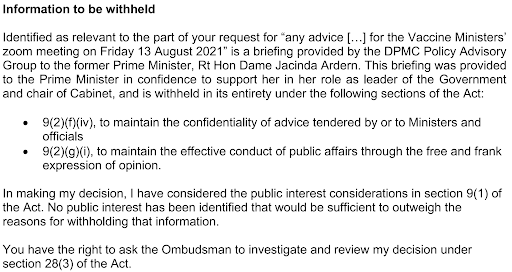
It said it was not aware of what may have been discussed at the meeting, but identified a Policy Advisory Group briefing prepared for Ardern in advance of it.
DPMC withheld that briefing in full under provisions protecting confidential ministerial advice and the free and frank expression of officials’ views.
DPMC, therefore, did not deny that the meeting occurred. Its response confirms that pre-meeting advice existed but provides no account of the discussion that followed. According to DPMC, “No public interest has been identified that would be sufficient to outweigh the reasons for withholding that information.”
The diary trail remains unclear
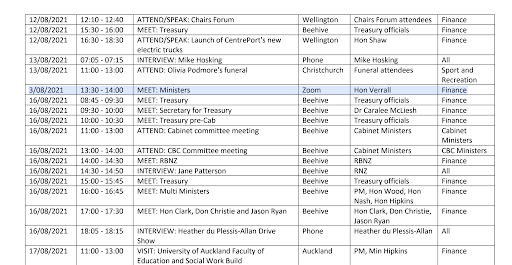
The publicly released ministerial diaries do not provide a straightforward account of the meeting.
At 1.30 pm, Ardern’s diary places her at a housing development visit in Mt Roskill, Hipkins’ diary places him at Mt Aspiring College in Wānaka, and Little’s diary places him at a health event in Taranaki.
All three are among those the Ministry says attended the Zoom meeting.
Robertson’s diary contains an apparent 1.30 pm Zoom meeting labelled “Ministers”, but it is dated 3 August, placed after entries for 13 August, assigned to the Finance portfolio and lists only Verrall. Maybe the 1 was just left off, innocently or otherwise.
The diary releases warn that unscheduled meetings may be omitted, that attendee lists may be incomplete and that published diaries are not comprehensive historical records.
Because the meeting was held by Zoom, the entries placing ministers elsewhere do not establish that they could not also have joined remotely. The three engagements also appear to have been arranged in advance, which raises a question about attendance at the regular Zoom meeting, but does not resolve it.
The diary discrepancies are therefore supporting evidence of an incomplete record, not proof that the meeting was deleted or concealed, although that also could be the explanation.
An obligation to keep records
The Public Records Act requires public offices to create and maintain full and accurate records of their affairs in accordance with normal, prudent business practice.
That does not necessarily require a verbatim transcript or formal minutes of every ministerial conversation.
But this meeting reportedly involved the Prime Minister, the COVID-19 Response Minister, the Health Minister, the Finance Minister, associate health ministers, the Director-General of Health, Medsafe and vaccine programme officials.
It reportedly took place days before the Cabinet approved Pfizer eligibility for 12 to 15-year-olds and while officials were considering dosing options, myocarditis risk and public communications.
In that context, the absence of any minutes or notes requires a proper explanation.
The public can see the options under consideration before the meeting and the outcomes that followed. What remains missing is the decision trail between them. The documents do not show whether the one-dose option or myocarditis wording was discussed, what advice Ardern received, or what role the meeting played in the final policy and communications.
It would therefore be unsafe to claim that the meeting itself decided these matters. What can defensibly be said is that, if it occurred, it sat directly within the decision sequence and that the absence of a meeting record prevents the public from determining what role it played.
The agencies involved should explain why no record was created, whether related material survives in ministerial offices or archived systems, and whether the briefing prepared for Ardern can now be released, at least in part.
Part three will examine why findings of this apparent significance have received little attention from much of New Zealand’s media.