“Here, on a hellishly ancient table-land fully twenty thousand feet high, and in a climate deadly to habitation since a pre-human age not less than five hundred thousand years ago, there stretched nearly to the vision’s limit a tangle of orderly stone which only the desperation of mental self-defense could possibly attribute to any but a conscious and artificial cause” –
H P Lovecraft, “At the Mountains of Madness”.
Many of Lovecraft’s stories inhabit a world where humans are not the first, nor will they be the last, civilisation on this planet. “The Great Race”, an interstellar civilisation which built huge cities on Earth in the Precambrian era, are featured in stories like “At the Mountains of Madness” and “The Shadow out of Time”. But Lovecraft was far from the only early 20th century writer to imagine pre-human civilisations.
Lovecraft’s epistolary friend Robert E Howard’s “Hyborian Age” features not only a forgotten epoch of kingdoms, sorcery and barbarian kings between the fall of Atlantis and the dawn of recorded history, but hints that non-human civilisations preceded them. The idea lived on in fiction through the 20th century: Lin Carter’s 1960s Thongor stories also feature a pre-human race of “Dragon Kings”. The Quatermass books and films likewise featured pre-human races on Earth. In the 1970s and ’80s, Michael Moorcock’s Elric of Melniboné ruled a decadent empire built on the bones of even older, stranger races, while the Dragonlance books also featured pre-human reptilian civilisations. Another 1980s author, Julian May, imagined an Earth settled, six million years ago, by a dimorphic alien race who left no fossil record, but whose personalities survived in the corpus of Celtic folklore.
Even the grand-daddy of them all, J R R Tolkien, built a Middle-Earth – our Earth, as he made clear in interviews – where humans are the ‘Second Comers’, only appearing in the world long after the gods and elves have inhabited it for tens of thousands of years.
The idea of pre-human civilisations was catnip for high fantasy and pulp writers: thrilling, atmospheric and utterly unfalsifiable.
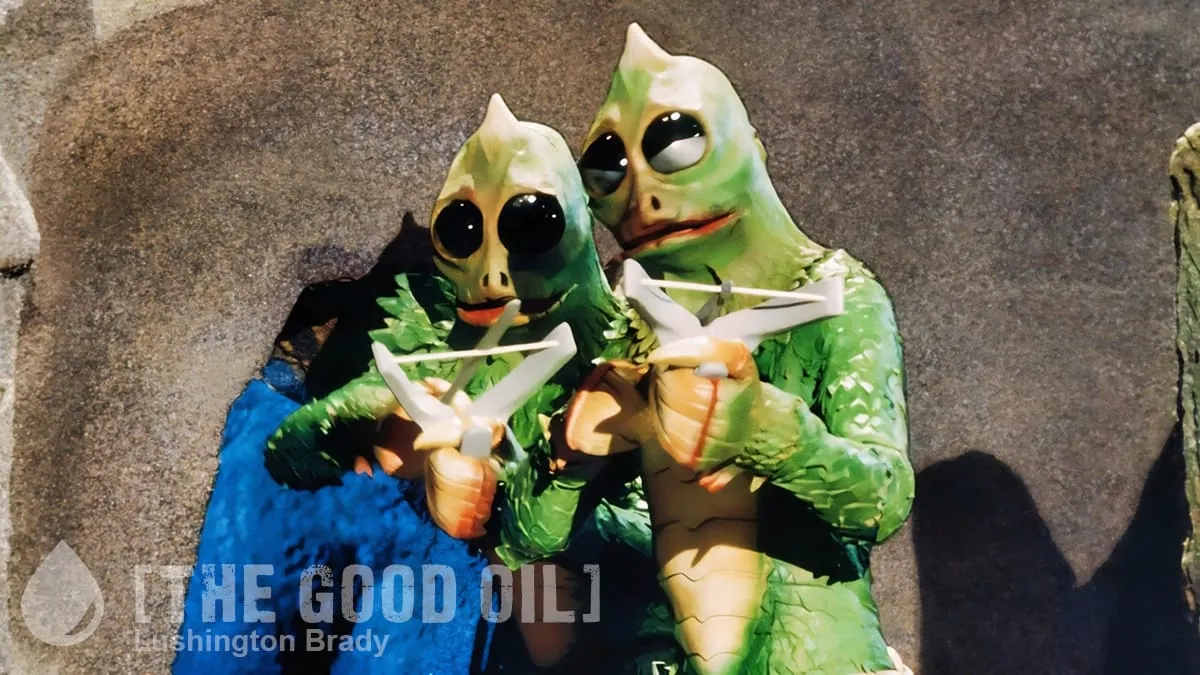
Fast-forward to 2018, and two serious scientists, NASA’s Gavin Schmidt and astrophysicist Adam Frank, decided to play the same game, but with graphs. They called it the “Silurian Hypothesis”, named after the intelligent reptile folk from Doctor Who. Published in the International Journal of Astrobiology, it wasn’t a claim that lizard-men once ruled Earth. It was a thought experiment: if an industrial civilisation existed millions of years before us, would we even know?
The honest answer, they concluded, is probably not. Earth is very good at erasing its past. A skyscraper built 100 million years ago would be dust. Plastics, concrete, even nuclear fallout would be geologically invisible after deep time (though wind turbine blades might still be around). The fossil record is laughably incomplete. Most species leave no trace at all.
Rather than Lovecraft’s Precambrian Great Race, or Howard’s relatively recent (in geological terms) Hyborian Age, Schmidt and Frank plumped, like Julian May, for a warmer, wetter Earth: the Paleocene-Eocene Thermal Maximum (PETM) about 56 million years ago, a time of a massive spike in CO₂, rapid global warming, ocean chemistry changes and extinctions. Beside the rather telling choice of a warm, wet Earth as optimal for the rise of civilisation, the paper itself admits natural explanations – massive volcanism and methane releases from seabeds – fit the data far better than the modern cult of human-induced warming. No need to invoke dinosaur industrialists.
The hypothesis has a delicious paradox baked in, which also holds a lesson for the Climate Cult. A civilisation that lasted long enough to matter would likely have become sustainable. The more sustainable it was, the less planetary damage it left. The less damage, the harder it is to detect. For all the blatherskite about a so-called ‘Anthropocene’, as it happens, our own industrial civilisation fits this pattern exactly: despite our utter reliance on fossil fuels, our ‘carbon intensity’ has plummeted. That is to say: humans today are making every molecule of CO₂ they release produce much more than it did 100, even 50, years ago.
With proper scientific humility, Schmidt and Frank carefully call their idea a “hypothesis”, not a theory. This matters in science. Science demands testable predictions and evidence, ‘falsifiability’, as Karl Popper dubbed it. If an ancient civilisation was so sustainable that it left no trace at all, then there’s no way to test the claims. The hypothetical ancient lizard men were just like Carl Sagan’s famous incorporeal, invisible, heatless-fire-breathing dragon: tantamount to no dragon at all.
So the whole thing is gloriously un-falsifiable. The Silurian Hypothesis assumes the evidence has been erased, then wonders why we can’t find it. That’s not a theory. It’s a scientific parlour game: an entertaining ‘what if?’, which is a perfectly valid thought-experiment.
TikTok mystics and ancient-astronaut cranks have, predictably, run with it. Lizard people from the oceans! Underground civilisations! Ancient legends of sea gods helping humanity! All very atmospheric, zero evidence. Turning folklore into geology requires more than vibes. A civilisation that survived from 56 million years ago until it could meet early humans 300,000 years ago, then disappeared without trace? That strains credulity past breaking point.
None of this diminishes the paper’s value as intellectual exercise. It’s a useful reminder of how little we actually know about deep time and how easily our species could join the ranks of the utterly forgotten.
The real lesson is humility. We strut about as if we’re the first and only technological species this planet has hosted. Maybe we are. Maybe we’re not. The geological record is too patchy to say with certainty. What we can say is that every previous dominant life form – trilobites, dinosaurs, giant sloths – eventually got the evolutionary chop. Hubris has a poor track record.
So enjoy the Silurian Hypothesis the way you’d enjoy a good Lovecraft story or a Hyborian Age yarn: as mind-expanding fiction that makes you ponder the impermanence of empires and the vast indifference of geological time. Just don’t mistake it for settled science. The Elder Gods, if they ever existed, aren’t leaving calling cards in the strata. And if they did, they’ve long since been ground to dust by the slow, relentless mills of tectonics.
Our civilisation will likely suffer the same fate. The question isn’t whether we’ll be remembered. It’s whether we’ll leave anything worth remembering or whether future sentient squid will one day ponder the faint chemical ghosts of our brief, noisy reign and call it the Anthropocene Hypothesis.
Maybe they’ll even write some rollicking good fantasy stories about us.