H P Lovecraft was not just the author of some of the greatest fiction of the 20th century: despite his lack of formal schooling, he was a remarkable autodidact in everything from 18th century poetry and colonial architecture, to science. As a teenager, he not only wrote a bulky, unpublished, manual of inorganic chemistry – most of his first published writings at that age were astronomy columns he wrote for Providence newspapers.
So, when he later wrote stories like The Shadow Out of Time, which relates the history of alien races who inhabited the Earth billions of years ago, he naturally chose as the site of their remaining ruins the truly ancient landscape of Western Australia. The Australian geological plate is so mind-bogglingly old that it is home to some of the most ancient rocks to be found anywhere on the planet.
And the most ancient river.
To understand the difficulty of charting a watercourse through deep time necessitates confronting a fundamental hydrological truth: ‘Rivers are poor archivists of their own past.’ They refuse the quiet permanence of fossils or the definitive birth certificates inscribed by volcanic magma. Instead, these liquid vagabonds wander across floodplains, carve into recalcitrant stone, and frequently abandon their ancient channels altogether, spending millions of years erasing the very forensic evidence required to establish their pedigree.
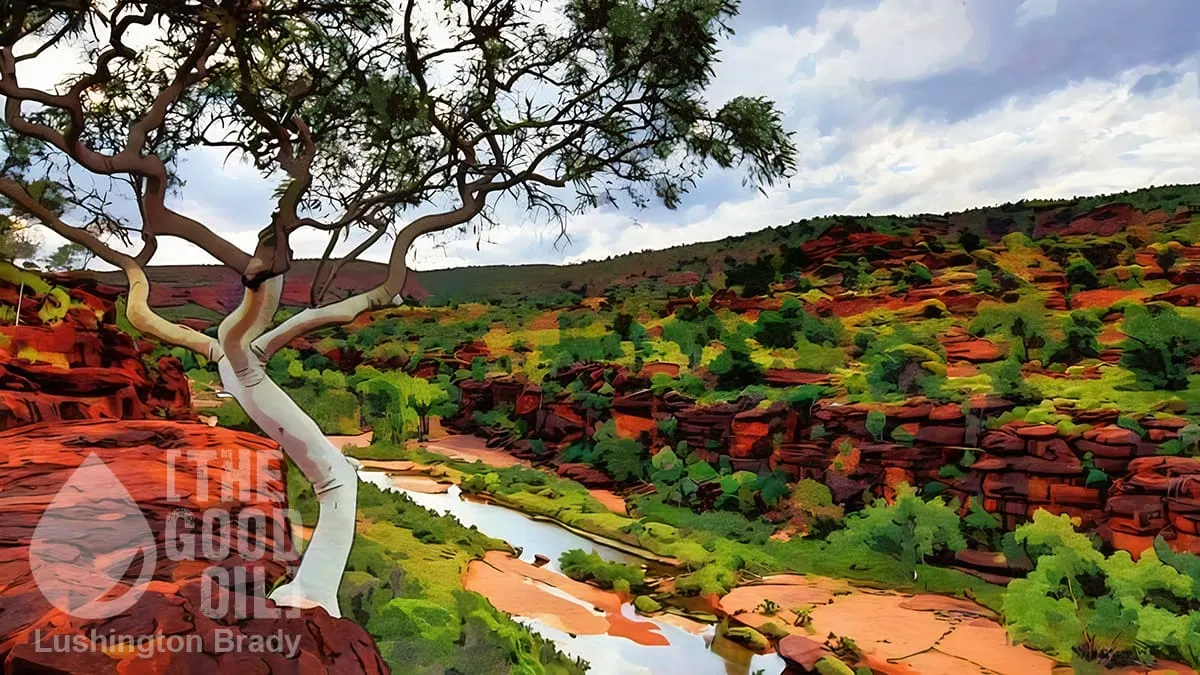
But ‘difficult’ is not ‘impossible’. With granitic doggedness, geologists have arrived at the most likely candidate for riparian senescence. The Finke River in Central Australia is believed to be an astonishing 400 million years old.
To put that into perspective, the Finke was already over 170 million years old when the first dinosaurs appeared. Indeed, land plants and animals were still something of a novelty, and the first forests had only just put down their roots.
To the casual observer during most of the calendar, the Finke looks less like a river than a desiccated chain of sandy reaches and saline waterholes baking beneath a merciless sky. Yet when the heavens finally fracture and the rains descend, a surging torrent of turbid brown water violently reclaims its ancient gorges.
But where most rivers are forced to make room for tectonics, meandering lazily around topographical obstacles, land-building geology has politely deferred to this fluvial gerontius.
As tectonic forces lifted the rocks, the river kept sawing downward, maintaining its path through the growing range.
This stubborn persistence makes the Finke what geologists call an antecedent stream, born before the jagged peaks of the MacDonnell Ranges were thrust upward during the Alice Springs Orogeny (geologists’ fancy term for mountain-building). While epochs shifted and supercontinents conjoined and fractured, this stubborn channel carved its testament into the ancient crust, defying the capricious restructuring of Pangaea and surviving the monumental gathering of Pangaea’s offspring, Gondwana.
Of course, the Finke does not reign entirely uncontested in the antiquarian stakes. Southern Africa cradles the Save River, whose origins are also tied intimately to the ancient rifting of Gondwana, while another Gondwanan descendant, India, offers up the Narmada, flowing stubbornly against the modern tectonic grain from a time before the subcontinent careened northwards to crash into Asia and raise the Himalayas. Meanwhile, perhaps the closest rival to the Finke in the pluvial Struldbrug club is Europe’s Meuse, which cuts through the Ardennes with a pedigree stretching back some 300 million years to Gondwana’s twin, Laurasia. Yet these European and Asian waterways are mere upstarts compared to the geological antiquity of the Australian interior.
Why, though, are there so few examples of rivers that are actually older than the hills? The mechanisms of aquatic mortality are manifold.
Stream capture, a parasitic geological phenomenon wherein an aggressive, ambitious tributary erodes backward and steals the headwaters of its neighbour, regularly redirects entire hydrological systems. Mountain-building exercises, such as the rise of the Andes, can utterly reorganise a continent’s drainage, while Pleistocene ice sheets have routinely obliterated ancient river valleys, as befell North America’s long-lost Teays River.
A river must avoid being dammed, buried, reversed, glaciated or erased by crustal violence, whilst retaining sufficient hydraulic malice to scour its trench through the rising stone.
Thus, the Finke River remains our most majestic testament to geological endurance: a drainage system that has beaten the cosmic odds, surviving through the crucible of deep time while civilisations and even continents rise, fall and are forgotten beneath the relentless southern sun. Whether this ancient corridor truly constitutes the ‘same’ river across four hundred million years is perhaps a question best left to the metaphysicians rather than the hard-headed stratigraphers.
Heraclitus might have argued that you cannot step into the same river twice, but had that ancient philosopher been transplanted half a world away, he could have stepped into the same streambed as dinosaurs – and even older creatures.