It’s hard to imagine Grant Denyer being hauled before Senate Estimates in Canberra, or Paul Henry being grilled by a parliamentary select committee at the Beehive. It’s also hard to imagine life without quiz shows (I’ll be honest and admit that I find Deal or No Deal bizarrely compelling). But, back in the ’50s, quiz shows became the subject of Congressional hearings and the entire genre almost disappeared until Jeopardy! revived it in 1964.
At the centre of it all was a mild-mannered Columbia academic, a top-rating quiz show and a whole lot of off-camera shenanigans.
Charles Van Doren was not some common huckster plucked off the suburban streets: he was native royalty to the American academic establishment. His father was a Pulitzer-winning poet who lectured in English at Columbia, his mother was a noted editor and his uncle had collected a Pulitzer for a biography on Benjamin Franklin. Young Charles dutifully followed this illustrious path, collecting degrees from Cambridge and a PhD from Columbia before settling into a quiet life of letters. Yet, despite his pristine pedigree and ivory-tower surroundings, he proved remarkably susceptible to the tawdry, flashing lights of early television.
At the time, the hit NBC quiz programme Twenty-One was suffering from a distinct malaise. Its reigning champion, a singularly abrasive fellow named Herb Stempel with a terrifying sponge memory, had caused ratings to plateau and sponsors to sweat. The producers, Dan Enright and Albert Freedman, desperately needed a fresh face: someone telegenic, wholesome and eminently sympathetic to rescue their sinking ship. They fastened their gaze upon Professor Van Doren, a man who, by his own later admission, did not even own a television set.
‘I’ve thought about it, Charlie,’ Freedman said, ‘and I’ve decided you should be the person to beat Stempel. And I’ll help you do it.’
And help him he did, with all the meticulous staging of a Pyongyang military parade. The legendary matches between Stempel and Van Doren were about as spontaneous as a professional wrestling bout. The unfortunate Stempel was ordered to take a deliberate dive by misidentifying the Oscar-winning film for 1955, paving the way for the golden-boy academic to seize the crown.
Once installed behind the podium, Van Doren was subjected to rigorous direction. The quiz was not a test of raw intellect, but a masterclass in theatrical suspense.
During his coaching sessions ahead of each episode, Van Doren said that Freedman “would ask me questions, I would answer them – and then he would tell me how to answer them: pause here; add this or that remark aside; always seem to be worried, anxious; never answer too quickly, let suspense build up.”
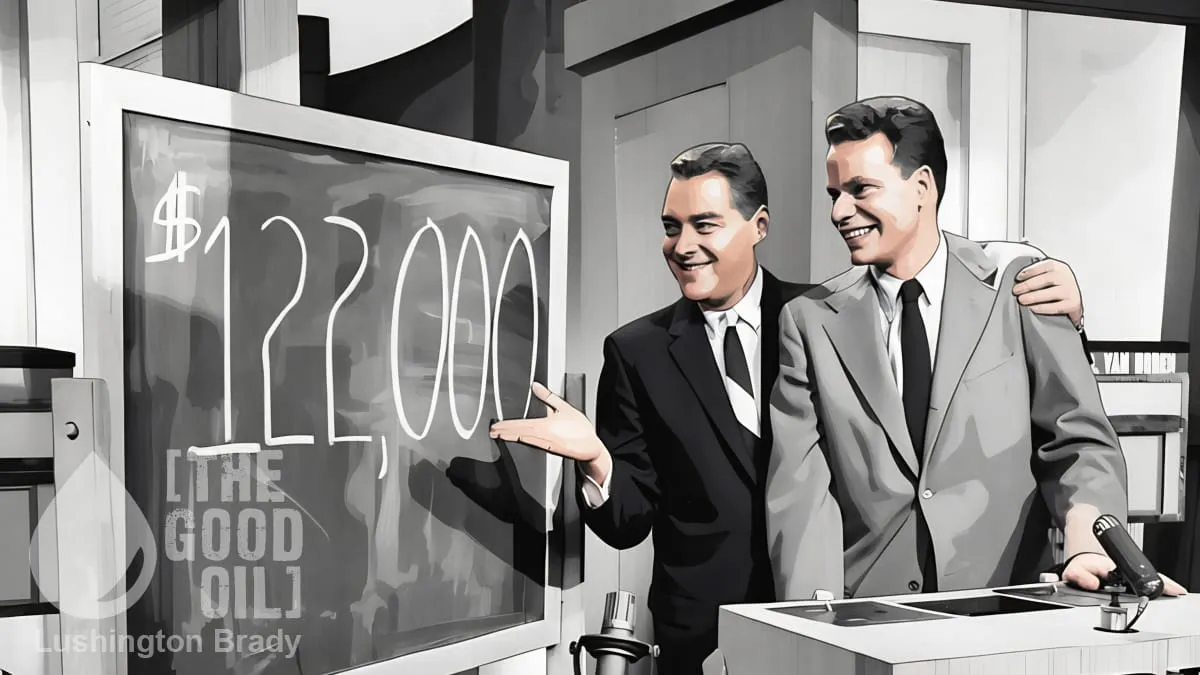
The public, naturally, swallowed the performance hook, line and sinker. Fan mail arrived by the tonne, smitten women staked out his apartment building and Time magazine plastered his mug across the cover under the breathless moniker ‘The Wizard of Quiz’. Before his inevitable defenestration by a rival contestant, Van Doren walked away with a king’s ransom – some $129,000, which represented an absolute fortune at the time – alongside a very comfortable berth as a cultural correspondent on NBC’s Today show.
Naturally, when rogues fall out, honest folk get the truth, or in this case, a jilted Stempel blowing the whistle on the entire enterprise. When the inevitable congressional inquiries began to loom, Van Doren initially adopted the time-honored political strategy of complete and utter denial, even retreating into rural hiding to dodge the authorities. But the charade could not hold. When he finally slunk into Washington to face the music, his confession was stark.
‘I was involved, deeply involved, in a deception.’
The fallout was biblical. Van Doren was promptly cast out of Columbia, dropped by his television paymasters and the wider game show ecosystem collapsed into a heap of smouldering ruins. It took the invention of Jeopardy! in the early ’60s to resurrect the genre from the grave. Van Doren retreated into quiet academic obscurity, spending his later years teaching and editing before passing away in 2019 at the grand age of 93.
Perhaps he spent his twilight years pondering the peculiar modern reality that civilisation apparently prefers a well-orchestrated lie to an unvarnished truth.