Greg Bouwer
IINZ
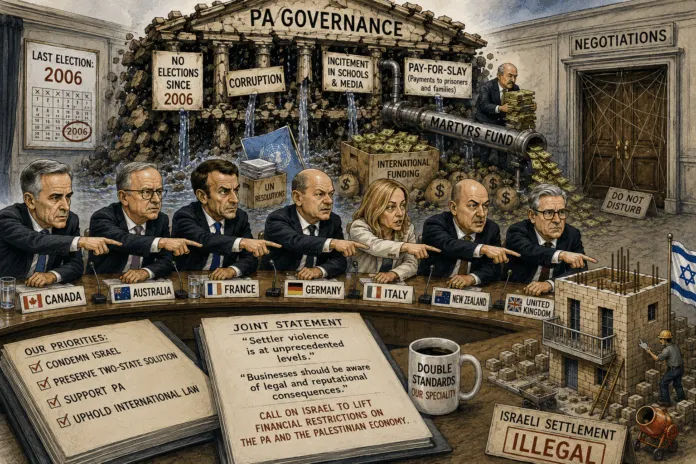
Last week, a coalition of Western governments – including New Zealand, Australia, Canada, the United Kingdom, France, Germany, Italy – issued yet another joint statement condemning Israeli settlement activity in Judea and Samaria (the “West Bank”).
The language was familiar. Settlements were declared “illegal”. Israeli actions were framed as threats to peace. Businesses were warned of potential “legal and reputational consequences” for involvement in projects beyond the Green Line. Once again, the international community signalled that Israel remains the central object of diplomatic pressure in the conflict.
What was absent was equally revealing.
There was no meaningful acknowledgement of the conduct of the Palestinian Authority itself: not its corruption, not its democratic collapse, not its continued “pay-for-slay” system rewarding imprisoned terrorists and their families, not its glorification of violence, not its refusal to hold elections for nearly two decades, and not its systematic avoidance of direct negotiations in favour of international pressure campaigns.
This asymmetry is no longer accidental. It has become structural.
The Palestinian Authority now occupies a unique position in modern diplomacy: treated as a state when convenient, and as a powerless victim when accountability arises.
For decades, the international system insisted that statehood carried obligations. States were expected to maintain functioning institutions, exercise territorial control, uphold the rule of law, prevent terrorism, and demonstrate political legitimacy. Yet in the Palestinian case, these requirements have steadily been relaxed, bypassed, or redefined.
The Palestinian leadership has received recognition, diplomatic privileges, treaty access, standing before international institutions, and even quasi-state status at the United Nations – despite lacking many of the traditional criteria associated with sovereign statehood.
At the same time, those same governments routinely excuse or minimise failures that would provoke international outrage elsewhere.
The Palestinian Authority, whose writ no longer extends to Gaza and which lost control there to Hamas in 2007, still maintains financial payment systems tied to imprisoned terrorists and the families of attackers. Critics argue the structure effectively incentivises or rewards terrorism because payments scale according to sentence length, meaning that more serious attacks often attract greater financial reward.
This is not merely an Israeli talking point. It was serious enough to prompt the United States Congress to pass the Taylor Force Act restricting aid to the PA. While the Palestinian leadership has periodically attempted administrative reforms and rebranding measures under international pressure, the underlying structure of payments tied to security offences and imprisonment has remained substantially intact.
Yet the same governments now warning businesses of the “legal and reputational consequences” of involvement in Israeli settlement activity are simultaneously calling on Israel to “lift financial restrictions on the Palestinian Authority and the Palestinian economy”. The asymmetry is no longer merely rhetorical. It has become operational.
The same pattern appears in discussions surrounding settler violence.
Violent attacks by extremist settlers do occur and should be condemned unequivocally. But the international narrative surrounding “settler violence” has increasingly become detached from methodological scrutiny. Advocacy organisations and media reports often aggregate vastly different categories of incidents – ranging from vandalism to confrontations involving both parties, incidents preceded by Palestinian violence or provocation, and unverified allegations – into singular headline figures that create the impression of systematic unilateral violence.
The statement asserts that “settler violence is at unprecedented levels” – a claim presented as uncontested fact despite the deeply contested methodology underpinning many of the datasets used to sustain such international assessments.
Examination of the underlying incident databases themselves raises further methodological concerns. The United Nations Office for the Coordination of Humanitarian Affairs (OCHA) dataset used to support many international claims tracks incidents “involving Israeli settlers and other Israeli civilians as either perpetrators or victims” – a categorisation that, by OCHA’s own description, captures dual-party confrontations rather than unidirectional settler aggression alone. The dataset also includes thousands of non-violent incidents within its broader reporting categories, including Jewish visits to the Temple Mount, infrastructure work, traffic accidents, and trespassing complaints involving no assault or property damage. Analysis of the published database has further identified that a substantial proportion of incidents classified as occurring in Judea and Samaria did not in fact occur there. None of this means extremist settler violence does not exist. It does mean that the metrics shaping international perception are often far less precise – and far less unidirectional – than the headlines built upon them.
This matters because metrics shape diplomacy.
Once embedded into institutional reports, repeated through UN mechanisms, amplified by NGOs, and echoed through international media, contested claims gradually harden into accepted political reality. Numbers cease to be debated and instead become moral shorthand.
And that, increasingly, is the true significance of statements like last week’s declaration.
The issue is no longer merely settlements themselves. The issue is the transformation of the conflict from a framework of negotiated compromise into one of permanent international adjudication.
For years, Western governments claimed their goal was to preserve the conditions for peace negotiations. Yet the cumulative effect of these policies has often been the opposite. Rather than encouraging direct compromise between Israelis and Palestinians, the international system has steadily incentivised bypass politics: diplomatic pressure campaigns, legal warfare, economic coercion, international tribunals, and symbolic recognition untethered from reciprocal obligations.
The result is a political culture in which Palestinian leadership can avoid difficult internal reforms while continuing to accumulate international legitimacy.
No elections? Recognition continues.
Corruption? Aid continues.
Incitement? Statements continue.
“Pay-for-slay”? Condemnation remains muted.
Meanwhile, Israel alone is treated as possessing full moral agency within the conflict – the only actor consistently expected to alter behaviour as a precondition for diplomatic legitimacy. Palestinian political failures are increasingly treated not as obstacles to peace requiring correction, but as conditions to be managed indefinitely by the international system itself.
This imbalance does not advance peace. It entrenches dysfunction.
A sustainable resolution requires accountability on both sides. That means recognising that Palestinian political failures are not peripheral irritants but central obstacles to peace themselves. A leadership that cannot build democratic legitimacy, restrain extremism, end terror glorification, or prepare its population for coexistence cannot simply be treated as a permanently blameless junior partner in the conflict.
Recognition without responsibility is not statecraft.
Systems that structurally reward political dysfunction rarely produce functional political outcomes.
This article was originally published by the Israel Institute of New Zealand.