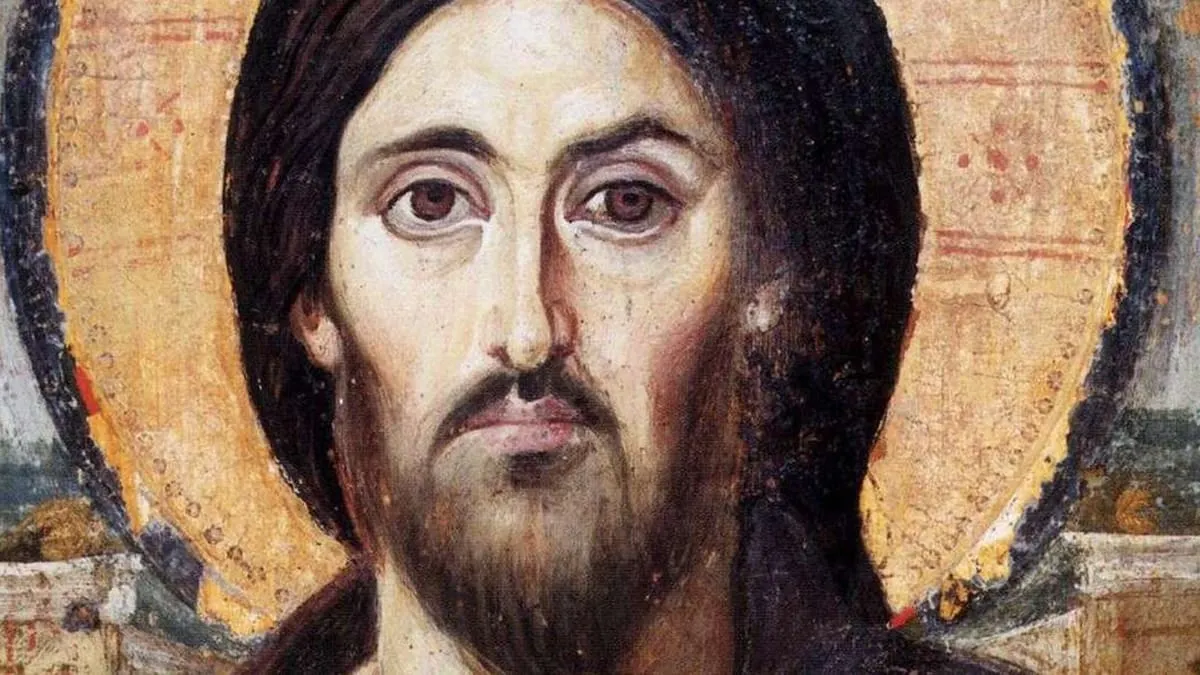
Atheism is a perfectly respectable philosophical position, but, for a crowd who like to brag about their logical chops, they sure make some dumb arguments. One of the dumbest is that ‘Jesus never existed’. Sure, we don’t have birth certificates or exactly contemporary narratives, but so what? The same goes for Muhammad, and no one questions his existence. Birth certificates were 1900 years away. And at a time when pretty much the only people who got books written about them were kings and generals, the life of a lower-middle-class craftsman in a Roman backwater being written about within a couple of decades is frankly astonishing.
So, that Jesus existed is not seriously up for debate. But what actually happened and who he was: that’s all another and far less easy to untangle matter. On his YouTube channel, Esoterica, Dr Justin Sledge gives it the ol’ college try.
Sledge calls his approach “critical maximalism”: take the New Testament and Christian tradition seriously as historical material, while applying the tools historians actually have. It’s a useful distinction. The historian can investigate what people probably did and believed; the historian cannot put the divine on a laboratory bench and weigh it. That doesn’t settle anyone’s theology. It does, however, stop us pretending that belief and historical method are the same enterprise.
It also makes for a more interesting question than the internet’s favourite two-button quiz: Was Jesus God or a fraud? Before anyone gets to that, there is a man in a particular place, among particular people, living under a particularly brutal empire. The first-century Galilee was not a stage set waiting for the Messiah to wander across it. It was a lived-in province, shaped by Roman power, local rulers, religious argument and the recurring prospect of rebellion: and the punishment that followed.
Sledge opens amid the turmoil after Herod the Great’s death. In his account, unrest and Roman violence form part of the landscape into which Jesus was born. The image is grim: crosses planted as public warnings, bodies left to make the point. The suggested details of Mary’s youth and pregnancy are far more speculative. Sledge wonders whether the family’s circumstances, and the stigma of an out-of-wedlock pregnancy, might help explain traditions about Jesus’ birth. That is a hypothesis, not a fact we can confidently print on a family tree. But applying Jewish law as it stood then, he notes that:
They’ve established erusin, but they’ve yet to have kiddushin according to Jewish law. She’s engaged to be married, but it’s not just the dreadful reality around them that keeps them silent. She’s missed her period, and their marriage is not fully legal, much less consummated.
The Gospels tell us little about Jesus’ early life. That silence has proved irresistible to storytellers, who have supplied childhood miracles, exotic travels and other adventures with the confidence of people who have found a blank page and mistaken it for a licence. It also provided fodder for those alarmed by this new faith metastasising out of Judaism, both Jewish and Roman.
That the father of the child was a Roman soldier was a rumor already current by the second century. Celsus claims that the father was just such a Roman soldier named Pantera or Pandera the panther, and subsequent Christian, pagan and Jewish sources continue to forward this narrative as slander or to reject it as just that.
The historical record gives us no such freedom. What we can say is that Jesus emerged as a Jewish teacher in Galilee, and that his public life belongs inside the debates and hopes of the Jewish world around him.
That point matters. Jesus is often treated as though he dropped from the sky with a new religion in his pocket, already labelled Christianity. But he lived as a Jew, spoke in a Jewish religious idiom and argued about Jewish law. Sledge’s Jesus knows the Torah and is at home in disputes about how to live it. His teaching has affinities with Pharisaic ethics, even when it pushes at the boundaries. The picture is not of an outsider rejecting Judaism, but of a reformist Jewish teacher working from within a diverse and contentious tradition.
“Diverse” is doing serious work here. As Mel Brooks once said, the Jews are history’s great dissenters: “Tell ’em something and they’ll break into a chorus of ‘It Ain’t Necessarily So’.” The Talmud is basically a Rabbinical shouting match.
’Twas ever thus, especially in the first century. The Temple and its priestly leadership mattered enormously; so did the people and movements that disagreed over religious practice, political accommodation and the future of Israel. Sledge sketches the Sadducees, associated with the Temple’s establishment; the Pharisees, concerned with the law’s meaning in daily life; and apocalyptic groups such as the Essenes, whose writings among the Dead Sea Scrolls imagine a cosmic struggle ending in God’s triumph.
There were also messianic hopes, some with a sharp political edge. “Messiah” meant an anointed person, an idea with royal and priestly histories. Under Roman rule, however, talk of a coming king was not an abstract exercise in biblical vocabulary. The emperor was a god and the city on the Tiber was in charge, and that was that. Any movement that hinted at a change of rulers could be viewed as a threat. Rome did not require a seminar on the finer points of theology before deciding that a would-be liberator was bad for public order.
Into this combustible world comes John the Baptist. In Sledge’s reconstruction, John preached repentance, immersed people and warned of a coming judgement. Jesus was baptised by him and joined the movement. That connection is one of the most important threads in Sledge’s account: rather than imagining Jesus beginning entirely from scratch, he sees him emerging from a movement John had already set in motion.
Jesus then appears to have made that message his own and more demanding. The call to repent becomes an ethic of generosity and care for the poor. Share food and clothing. Do not use power to exploit others. Love enemies: do not answer violence with the comfortable satisfaction of revenge. These are not merely pretty sentiments to be embroidered on a cushion. They ask people to behave differently while living in a society structured by wealth, status and coercion. In the classical world, they were nothing short of revolutionary.
The urgency in this teaching is tied to the expectation that God’s judgement was near. If the world as people knew it was approaching its end, ordinary calculations of advantage might look rather less sensible. Why cling so tightly to wealth, or demand repayment, if the great reckoning was at hand? That logic can sound alien to modern ears. It was also a sharp challenge to the assumption, more ubiquitous then than even now, that the powerful are powerful because the universe approves of them.
Sledge draws attention to the apocalyptic currents running through the period. In this way of thinking, history was not simply a succession of kings and tax increases. It was the arena of a struggle between good and evil, with God ultimately intervening to judge the wicked and vindicate the righteous. The Dead Sea Scrolls show that such expectations were not some private eccentricity invented by Jesus. They were part of a wider Jewish religious world, though groups differed on what the end would look like and how to prepare for it.
Sledge’s suggestion that John and Jesus might have represented two different messianic roles – a priestly figure and a kingly one – is intriguing, but it needs to be kept in the right box: interpretation, not established biography. The ancient evidence does not hand us a neat organisational chart of the movement, complete with job titles and succession plans. The historian’s job is not to sand away the uncertainties until every interesting theory looks like a fact.
Jesus’ healings and exorcisms belong to the same world of religious expectation. Sledge puts them in the context of ancient practices in which healing and the expulsion of spirits were familiar ways of understanding illness and misfortune. For believers, the stories may testify to divine action. For the historian, they also show how Jesus and his followers understood their work: not as an abstract lecture on evil, but as a confrontation with it in the lives of suffering people.
That is a more complicated portrait than either side of the modern culture war tends to prefer. Jesus was not simply a celestial visitor handing out timeless platitudes, nor does describing him as a Jewish apocalyptic teacher explain away the movement that formed around him. A man can belong to his age and still disturb it. Indeed, that is often how disturbance works.
Sledge sees Jesus gathering 12 followers, a number with obvious resonance in a tradition organised around the tribes of Israel. The group suggests not just a travelling lecture circuit but a symbolic picture of a renewed Israel. Jesus also speaks of the “son of man”, language drawn from Jewish apocalyptic thought. What exactly he meant by it, and whether he identified himself with the figure, are questions of interpretation. The later Christian answer should not be smuggled in as though it were automatically the only first-century answer.
Then there is Jerusalem. Passover brought crowds to a city already charged with memories of liberation from foreign domination. A teacher arriving with followers, acting out a challenge to the Temple’s authority, and preaching about God’s kingdom was not going to be mistaken for a harmless motivational speaker. The Temple was a religious centre and an institution woven into political and economic life. An action there could communicate more than its immediate practical effect.
The Gospels present Jesus’ arrest and execution against this volatile background. Sledge’s account emphasises the logic of power: local authorities feared disorder, and Roman rule was not famous for responding to unrest with patience and a listening circle. Jesus was crucified under Pontius Pilate, the Roman prefect. Crucifixion was an imperial punishment, public and degrading. It was designed to warn others what happened when someone was understood to threaten the order of things.
That much is grimly intelligible without pretending we can reconstruct every conversation in the arrest, trial and final hours. The accounts were written with theological purposes, and historians weigh them accordingly. Sledge builds a plausible narrative from the sources, but plausibility is not a time machine. Where he moves from what the texts say to what he thinks might have happened, the distinction matters.
The movement did not end with Jesus’ death. Sledge gives particular weight to James, Jesus’ brother, and the Jerusalem community. That tradition appears to have remained closely tied to Jewish practice and to the expectation of God’s coming kingdom. This is a useful corrective to the easy assumption that Jesus’ followers immediately became the Christians of later centuries, with all the arguments already settled and the paperwork neatly filed.
Paul’s role was different. In Sledge’s telling, Paul’s message gave Jesus a cosmic significance: a pre-existent divine figure, whose death and resurrection were central to the redemption of humanity, and whose return would bring judgement. A Jew and a Roman citizen, Paul’s mission carried this message beyond the original Jewish setting, to Gentile audiences. The result was not simply Jesus’ teaching, unchanged and delivered to a larger room. It was a theological development with consequences large enough to reshape the religious map.
Sledge describes the New Testament as preserving traces of distinct strands: the movement associated with John, the Jewish teaching and followers of Jesus and James, and Paul’s Gentile mission. That is a provocative way of reading the texts, not a verdict everyone must accept in every detail. But it is a valuable reminder that the New Testament did not arrive as one seamless document composed in a single afternoon. It is a collection of writings from communities trying to make sense of an extraordinary and, by ordinary political measures, catastrophic ending.
That is where the history becomes more than a dispute over whether a first-century preacher had the right paperwork. Sledge’s reconstruction asks us to imagine Jesus not as a figure floating above history but as a person whose world shaped the questions he asked and the dangers he faced. The kingdom of God, in that world, was not merely a private feeling of spiritual wellbeing. It spoke to judgement, justice, power and the conviction that the existing order was not the final word.
One can accept that historical picture without accepting every theological claim later made about Jesus. One can also believe that faith sees more in him than historical method can establish. The tension between the two is where Christianity happened and still happens. Neither side gains anything by pretending to be the last word. The sceptic who claims that a historical Jesus is impossible has gone further than the evidence warrants; the believer who treats every detail of a scholarly reconstruction as settled revelation has made the reverse mistake.
The sensible approach is less theatrical: attend to the evidence, notice where the sources are silent and mark the line between an argument and a fact. Sledge’s best contribution is not that every conjecture must be adopted. It is that Jesus becomes more intelligible when restored to the Jewish, Roman-occupied world in which he lived. That world was crowded with religious argument, hopes of deliverance and rulers anxious to keep the peace: usually by reminding the restless what a cross was for.
The Jesus who emerges is not less interesting for being historically situated. He is more so. He belongs to a particular people and a particular time, yet his movement survived the death that should, by the empire’s reckoning, have extinguished it. The story then changed as it travelled: from John’s baptismal movement, through the community around James, into Paul’s expansive theology and the religion that came to be called Christianity.
There is no need to confuse that complicated history with proof of every later claim. But neither is there any intellectual virtue in pretending the man himself evaporates because the sources are imperfect, or because the surviving evidence asks us to think rather than merely sneer. Sledge’s lecture is an invitation to do just that: separate what can be argued from what must be believed, and look at the history without demanding that it be tidier than history ever is.
That Jesus existed is the easy part. The harder questions – what he expected, what he taught and how his followers came to understand his death – are where the real work begins. And if the history refuses to sit quietly in either the atheist’s neat dismissal or the believer’s ready-made dogma, well, that is not a defect. It is a reminder that the past is made of people, arguments and consequences, not slogans and dogma.