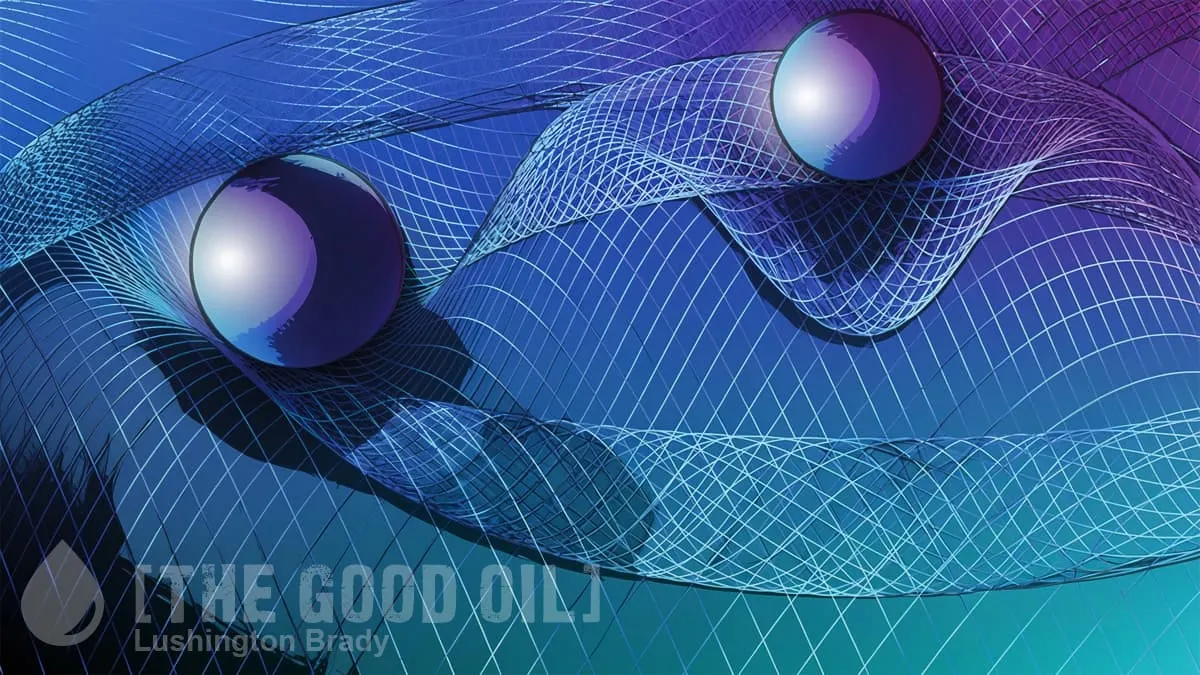
Physics for the last century has been ruled by two stunningly successful theoretical frameworks: relativity and quantum physics. Both have been validated by experiment to an extraordinary extent. Neither is even close to being dethroned in their domain: relativity for very big things; quantum physics for very tiny things.
And there’s the problem: each rules supreme in its domain – but neither wants to talk to the other. At the extremes, they break down. The numbers, as Slartibartfast said, are awful. The maths end up shouting at each other. So, the big dream of modern physics is getting relativity and quantum physics to kiss and make up.
A big step in doing so would be coming up with a proper theory of quantum gravity.
As far as we know, our physical world is governed by four fundamental forces: electromagnetism, weak and strong nuclear forces, and gravity. Apart from playing with bar magnets or marveling at the light of a rainbow, it’s gravity that we’re most familiar with here on Earth. Yet, it’s actually the least understood force of the bunch.
That gravity exists is not the problem: it’s explaining the how that’s the issue.
Newton gave us apples and planets. Einstein replaced the tug with a dent: mass tells spacetime how to curve, and curved spacetime tells mass how to move. General relativity is so good that GPS satellites have to correct for it or your maps would lie. Quantum mechanics is so good that the chip in your phone would be a paperweight without it. Put them in the same room, though, and the equations throw a tantrum. Try to describe the centre of a black hole, or the first instant after the Big Bang, and the maths produces infinities: which in physics is a polite way of saying ‘we have no idea’.
Theorists and experimentalists around the world have toiled for decades to compose a so-called “theory of everything” that would unite quantum explanations of the very small with the classical physics of the very large (such as humans and planets). A verifiable theory of quantum gravity is at the center of this quest to offer a single theory that explains everything in our universe.
Quantum gravity is the attempt to make gravity play by quantum rules. In the Standard Model, forces have messenger particles. So, gravity should have one too: the graviton. Except, write the graviton into the existing equations and they explode. That’s even before anyone figures a way to detect them. That is the whole problem in a suitcase. You need a framework in which spacetime is grainy at the smallest scales, gravity comes in quanta and the answers stay finite when you ask rude questions about singularities.
Enter string theory, still the least-worst story on the blackboard. The late-1960s idea, since grown into a family of variants, is that the universe is not made of point-like particles but of tiny vibrating filaments. Different notes on the string are different particles. One of those notes, if the theory is not a beautiful dead end, should be the graviton. To make the music work you need extra dimensions – 10 or more – of which we notice only the familiar four of space and time. The rest are curled up: scaffolding we cannot see.
Unless…
The more unsettling corollary is that gravity might not be ‘fundamental’ at all. Spacetime, and the tug we call weight, may be “emergent properties created by the quantum entanglement of particles”. Think of heat: we know now there’s no such thing as phlogiston, just molecules moving faster.
Caltech theorist Kathryn Zurek puts the motive simply:
For many reasons, we believe that the fundamental understanding of gravity needs to be quantum mechanical in nature […]
It’s believed that when we understand string theory well enough… that we’ll understand how to add the matter of the standard model into that theoretical structure of quantum gravity, but it’s not known how to do that [yet].
The catch, and it is a large catch, is that elegance is not evidence. String theory has an embedded, mathematically pretty account of gravity. It has not told anyone how to fold the rest of the Standard Model into that structure.
Experimental proof is a long way off, if it is coming at all. A theory that can be tuned to fit almost anything risks explaining nothing.
That is why people like Zurek are trying to drag the argument off the blackboard. The GQuEST experiment – Gravity from Quantum Entanglement of Space-Time – is a table-top cousin of LIGO. Photons bounce between mirrors with path lengths measured to mind-boggling precision (physics, unlike certain other ‘sciences’, doesn’t treat computer models with error margins larger than the phenomenon being ‘measured’ as ‘settled science’: physicists have standards). The hope is to see tiny jitters that would be the fingerprint of gravitons, or of spacetime itself flickering at the quantum scale. If they see something in the next five to 10 years, it would be the first peek at gravity behaving like a quantum citizen. If they see nothing, the strings can keep vibrating in private.
Until then, physics remains a house with two magnificent wings and no corridor between them. Relativity still runs the planets. Quantum theory still runs the atoms. The kiss-and-make-up remains a rumour.
And Slartibartfast, one suspects, would still find the numbers awful.