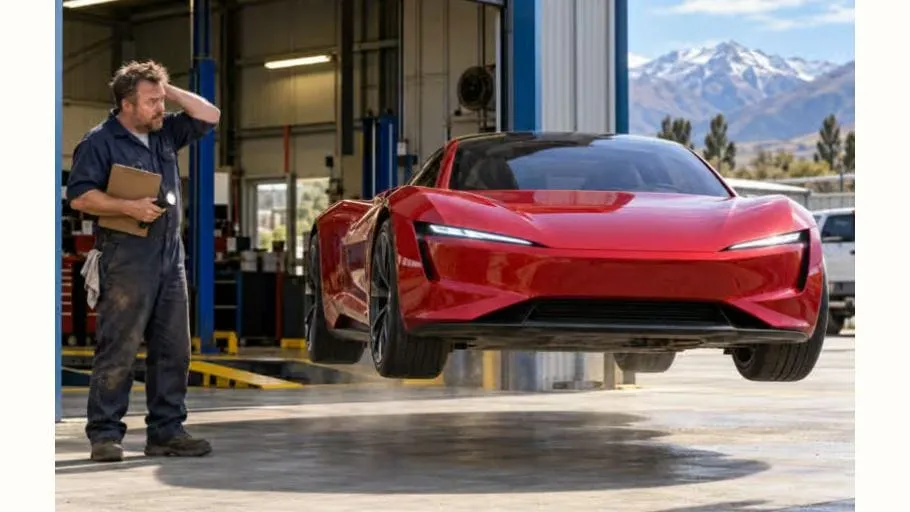
JD
In the Department for Climate Catastrophe (DCC), temperatures were rising. Not by much, since the motion to turn down the office air-conditioning to save the planet – moved by the DCC’s youngest and therefore most frightened employee – (“How my work pays off,” thought Greta, the department’s ‘Director for Scaring Children’) – had been voted down by the department’s older employees, who knew it wouldn’t make a blind bit of difference – especially if we don’t cut out the cows*
*Reference the latest report – “The Art of the Fart. Creative ideas in the Fight against Flatulence ” – published on April 1st, 2026, by the United Slaughterpersons’ Union (Whose motto, shown below, won a Palme D’or at the International Climate Catastrophe Carnivalé for the way it managed to state both objective and process in three short words.)

Questioned on motives, the USU’s secretary said, “Climate change is the union’s sole concern and any uplift in freezing works throughput, increasing job security for our members, never even crossed our minds.”
(He then left the union job to step across to a safe Labour seat in parliament, where the ability to make such comments with straight face is the harbinger of a promising career).
But I digress. The sweat on the brow of the DCC staff wasn’t due to concern over cows, or the threat of anyone going defcon on the aircon.
It was due to the latest news from the Intergovernmental Panel on Climate Change (IPCC) – a United Nations organisation, based lakeside in Geneva, where international bureaucrats, across multiple agencies, hold urgent conferences about humanity’s impending collapse over €40 salads and excellent wine. (The words, ‘nice work’ and ‘get it’ do spring to mind).
In addition to its Geneva headquarters, the IPCC also, concerned as it is with global emissions, invests heavily in international conferences, flights, hotels, highly paid bureaucracy and a permanently expanding global climate-administration industry – but you have to speculate to accumulate when you’re saving the world – I think.
Anyway, it seems that Representative Concentration Pathway 8.5 (RCP8.5), the main plank of the climate change doomsday predictions developed over the past 20 years, has just been declared “implausible” (something that the DCC had always thought was even more implausible) but there you are: IPCC have changed their mind so suck it up.
“It’s a bloody mess,” said Doomsday Scenario Director Hector – “We’ve been using RCP8.5 to forecast coastal and flood hazard maps, development restrictions, infrastructure costs and ‘managed retreat’ policies that have complicated insurance, lending and subdivision approvals and even reduced property values.” (Although the latter was probably a good thing, allowing Gen Z a better chance of getting on the property ladder – damp though the first few rungs might be – so that’s a plus, isn’t it?)
Under RCP 8.5, the sea-view set were expecting to abandon their beachfront properties as polar bears, stranded on rapidly melting ice floes, floated by and Category 12 hurricanes uprooted solar panels whilst turbine rotor blades spun so fast that entire windfarms reached liftoff velocity – on a good day!
Accordingly, councils drew hazard lines across half the coastline, insurers developed nervous tics, and perfectly dry hill sections acquired flood warnings lest the Pacific Ocean launch a surprise assault up the driveway sometime next week.
(‘Oh, how a good doomsday scenario lets us dictate to the masses and boosts our feeling of self-importance,’ thought the assembled DCC staff – ‘Certainly not something we should give up lightly, that’s for sure.’)
‘But wait, there’s more,’ said Hector, echoing a commercial on the shopping channel which, being a civil servant of long standing, he spent most of his day surfing. ‘Based on preliminary estimates, the new scenario framework brings projected 2100 temperature increases down by half, plus those scenarios with the most rapid rates of emissions reduction have also been retired, affirmation that the 1.5 Celsius temperature target of the 2015 Paris Agreement is unfeasible.’
Implausible and unfeasible. At the same time. The fear that the sky might be falling, without any help from global warming, left the DCC staff feeling as limp as a Wellington airport windsock on a still, wet Wednesday.
Sensing the gathering storm clouds, the director of DCC (D.DCC), decided it was time to speak up and restore morale. His credentials? Well, D.DCC was an old retainer who’d been given the climate change gig initially as one of the few people in the public service who could calculate Fahrenheit into Centigrade.
But then, luckily for him, as the hot air from the climate catastrophe lobby inflated both the size of the department and co-incidentally the size of his job, he had ballooned in importance.
‘Fear not,’ he said, ‘We’ve been here before – remember when we were just NIWA and how we survived the Seven Station Series controversies in 2009?’ [Look it up].
‘Armed with supercomputers, consultants, a limitless supply of coloured hazard maps and backed by the bottomless resources of the Crown Law Office, we stood ready to save New Zealand from any claims that our long-range forecasting of impending disaster might, in any way, be overstated.
‘And we succeeded – in 2012 – so three years of litigation didn’t use up too much departmental time (and the diversion did give us something to do when it wasn’t raining).
‘Anyway, even if the current apocalyptic claims now seem unwarranted, there’s always something new we can dig up to scare the kids (at which Greta, feeing her job secure again, heaved a sigh of relief). So let’s workshop a holistic roadmap to leverage our core competencies and stakeholder synergies while drilling down into the bandwidth issues and socialising the outcomes across the wider ecosystem.’
(And people said last week’s senior management seminar on ‘Blue Sky Thinking’ was a waste of time D.DCC thought to himself.)
And so it came to pass that the whole of the DCC staff bent to the task, and, after heaps of days and even higher heaps of holistic roadmap workshops, the answer dawned: “If all of the 127,031 risk assessments we’ve done over the past 20 years based on RCP8.5 are wrong, We’ll. Just. Have. To. Redo. Them. All. – Hallelujah!
A massive workload increase, which should secure DCC jobs through at least three more government changes, and anyway, sooner or later the Greens are bound to get in and demand we reconstitute the old assessments – so, all things considered, we can sleep easier in our cozy beds. (Is it me, or does it seem colder at night these days? – Climate change maybe? Or just winter? I’m not sure.)
What’s more, the DCC staff realised, whilst they were doing the new calcs, it would be necessary to keep the old disaster assessments in place for as long as that takes.
‘Yes team. We can continue to spread panic even as we calculate that panic isn’t actually necessary. – Sweet irony, and a win-win situation for the power of the DCC all round I should say,’ said Hector.
And so it transpired. Headcount doubled. Something very easily achieved as there were a plethora of young, unemployed BA graduates with degrees in ‘Earth Sciences’ lying around on Jobseeker just waiting to be taken on (and in).
Greta, the Director for Scaring Children, gained an assistant who, serendipitously, wore a pointy hat, had a wart on their nose, and drove a vintage 1970 Buick Gran Sport GSX V8 with the personalised number plate B’STICK1. (In violation of strict Waka Kotahi NZ Transport Agency rules, they painted the apostrophe in themselves. Rules? Made to be broken I say.)
Then the following week, as news of his motivational skills was bruited abroad, D.DCC was transferred to the IRD (where morale was in sore need of improvement having not done so previously, despite the floggings having stopped when Grant Robertson stepped down as minister of finance).
In the new job, D.DCC’s previous 30 years of experience in climate science and Fahrenheit to Centigrade calculation was of no value whatsoever – but ‘management is management’ as Sir Brian always says.
And it did swell his package, to the point where, on retirement he was able to afford a character home in Kelburn, living there contentedly until the fateful day when the roof collapsed on him under the weight of the solar panels it was never designed to carry, and he rose, permanently, to the verdant and temperature controlled fields of Elysium.
Despite the dual elevation of D.DCC – (replaced at the DCC by the transfer of the head of the ministry for cultural heritage, thus bringing even more creativity, but little actual knowledge.) – the department staff beavered away recalculating all of the 127,031 disaster scenarios that needed recalculating. And this continued until that momentous day when the Green Party finally made it onto the government benches.
At this point, with job security guaranteed, the DCC quadrupled in size and its emissions rose to match the combined output of three Chinese coal-fired power stations. (So, not much in the grand scheme of things. And anyway you’ve got to put in the hours before you can reap the benefits – isn’t that what the capitalists say?)
Then, as a final twist in the bovine tail, ‘The Art of the Fart’ was made into a movie (An Inconvenient Truth 3, endorsed – for a suitable fee – by Al Gore, ‘Mr Catastrophe’ himself).
It starred Andy Serkis as the troubled protagonist, torn between saving the planet by turning over his dairy farm to pine forest and shipping his cows to a factory farm in Kazakhstan – or just minding his own business.
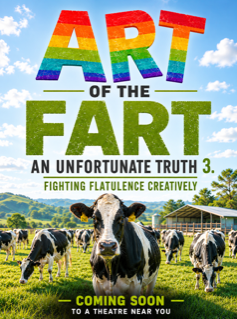
Alas – and despite reaching number one at the box office, AotF was pipped at the post for the Oscar(TM) by a remake of “How Green was my Carbon Neutral Valley” (which, after some initial controversy, was accepted as a nominee, despite it being 92 per cent generated by an emissions-heavy AI programme).
Ah yes. AI. Now that’s a totally different African-American in the woodpile. It’s possible, over the next 10 years, that AI will cause a 25 per cent cut in office jobs (and the public service back office jobs are exactly what it says on that tin) so more trepidation, but that’s a whole, holistic roadmap for another day.