It’s Friday the 5th of April 1968, halfway through the fourth year of the Labour government led by Harold Wilson. The Beatles are banging out “Lady Madonna”, Tom Jones is murdering “Delilah” and Cliff Richard is ‘Congratulating’ himself on his expected Eurovision Song Contest win at the Albert Hall to come on the following night.
There was general dissatisfaction among the public with the performance of Wilson’s government, both on the left and on the right, but serious dissatisfaction within the armed forces of the nation which had all seen huge defence cuts since it came to power. Nowhere more so than in the crew rooms of the Royal Air Force.
Since 1964 it had seen 20 bases closed, a reduction in personnel from 150,000 to 100,000, a cut in aircraft numbers from 1,650 to fewer than 1,000, the cancellation of the BAC TSR2, the HS P1154, the HS681, and the purchase of American aircraft instead. On the 1st of May, Fighter Command and Bomber Command were scheduled to amalgamate to form Strike Command which would also draw in Coastal Command, Air Support Command (formerly Transport Command) and Signals Command at a later date. Sic Transit Gloria.
On top of all this, the most offensive 'crime' of all in the eyes of many serving RAF personnel, was the failure to properly celebrate the 50th anniversary of the founding of the Royal Air Force on 1st April 1918 with a mass fly-past or a series of flypasts around the country and over the capital. No formal flypast was to take place, only a series of parades and an anniversary dinner were to serve as reminder to the nation of the Service’s proud, if short, history.
One young officer pilot was so incensed that he decided to take matters into his own hands. Flight Lieutenant Alan Richard Pollock was a flight commander on No1 (Fighter) Squadron, the world’s oldest military air squadron with a history stretching back to 1911, based at RAF West Raynham near Fakenham in Norfolk. He had joined the RAF as a cadet at the RAF College Cranwell in 1953, trained subsequently as a fighter pilot and served in that role in West Germany and the Middle East before being posted to No1(F) Squadron. He had also been an instructor at RAF Valley, Anglesey and a member of the Yellowjacks aerobatic display team flying the Folland Gnat T.1, the forerunners of the Red Arrows. He was rated by his commanding officers as an exceptional fighter ground attack pilot.
He had organised ‘leaflet’ raids over other RAF bases after the parades on 1st April by loading bundles of celebratory leaflets under the flaps and putting government-issue toilet rolls under the airbrakes of their Hawker Hunter FGA9s. He and his team then ‘leaflet and bog-roll bombed’ and ‘beat up’ selected bases such as Wattisham, Coltishall, Chivenor and Valley. Chivenor and Valley responded positively but there were serious litter complaints from the commanding officers at Wattisham and Coltishall, both of which were shortly due to have their annual inspections.
There had been nothing laid on for the NCOs and airmen, many of whom didn’t know the significance of the date – except at RAF Tangmere, near Chichester in West Sussex. Tangmere, a famous Battle of Britain airfield which had been earmarked for closure, had organised a parade and a big party for Thursday 4th and had invited No1(F), which had been one of its flying squadrons during the Battle of Britain, to send some aircraft to fly over the parade in Chichester and for the pilots to attend the party afterwards.
Five Hawker Hunter pilots of No1(F) duly obliged. Alan Pollock was one of them but in the period leading up to the parade and fly-past he had suffered from a heavy cold and had ‘self-medicated’ in an effort to ensure he would be fit on the day. It hadn’t worked so he’d gone to the station medical officer who prescribed something a little more powerful, which he told Pollock would ‘make him a bit sleepy’. It had the opposite effect.
On the 4th they took off from West Raynham, performing over Brighton’s air display en-route before arriving on time to the second over Tangmere’s parade and back round over Arundel Castle before landing at Tangmere, where they were met by visitors and representatives of the press. The Tangmere cocktail party and dance in the evening was a ‘blast’, attended by the Duke of Norfolk and the Air Officer Commanding 38 Group, Air Vice-Marshall ‘Mickey’ Martin of ‘Dambusters’ fame, the Mayor of Chichester and sundry other senior RAF officers. Pollock, by his own admission, gave vent to his opinions in traditional fighter-pilot style to anyone within earshot about the poor national celebrations and what he saw as the reductions in the fighting effectiveness of the RAF.
He had little sleep that night due to a combination of champagne, beer, the drugs he had taken and being awakened by a helicopter from nearby RAF Thorney Island. While lying awake he had brooded about the week in which he felt the RAF had been sold short, and he mentally reviewed the recent government decisions affecting the RAF. Something, he decided, had to be done. Someone had to make a statement. And that someone would be him. A celebration flag-wave was in order – over Parliament, Downing Street, the MOD and the RAF Memorial on the Embankment.
Friday 5th April dawned perfectly. In fighter-pilot speak it was ‘8/8th blue’, gin-clear. After breakfast the significance of what he and his squadron comrades were about to do struck him. They would almost certainly be the last pilots to take their fighter aircraft off from a famous RAF fighter airfield and the other pilots, probably a little hung-over, had been lukewarm about the idea of another ‘beat-up’ anywhere on the way back to base. Quietly, and without fuss, he marked a route on his low-flying map, scribbling rough headings and timings for various planned speeds along with some fuel check points. Nonchalantly he folded the map and stuffed it into the calf pocket of his flying suit and wandered into the airman’s crew-room where he borrowed an AA handbook to have a brief look at a somewhat inadequate map of central London.
When the five took off one after the other, Pollock was wondering how he would manage to break away from them when he was presented with the perfect opportunity – his squadron commander who was behind him had a change of heart and turned back to ‘beat up’ Tangmere airfield in a final farewell. He slipped away from the first three, descended to low level heading north and feigned an R/T failure. He knew his route would take him close to Hawker’s airfield at Dunsfold, the birthplace of his beloved Hunter FGA9. A quick jink and acceleration and he streaked, blue-noting, at tree-top height across Hawker’s hangars.
Two minutes later he was at the lakes just south of Heathrow, which he had chosen as his initial point. Turning right, he flew under a Boeing 707 on its final approach then across Richmond park to pick up the brown snake of the Thames and follow the river keeping his eyes open for helicopters. Sweeping over Wandsworth, Battersea and Chelsea bridges, he picked up Vauxhall bridge and there, a mile ahead, was Charles Barry’s neo-Gothic masterpiece, the beating heart of the nation.
Climbing slightly, he applied full power to keep his turns around parliament tight, knowing it would rattle the window frames and “let them know they still had an air force”. The message was received in the House and a debate was interrupted. Three times he circled the Palace of Westminster, but he had to alter his radius because Millbank Tower, which hadn’t been there the last time he had visited London, got in the way. He could not pick out Downing Street so, keeping well clear of Buckingham Palace, he again followed the river eastwards, dipping his wing at the RAF Memorial on the Embankment as he flew past.
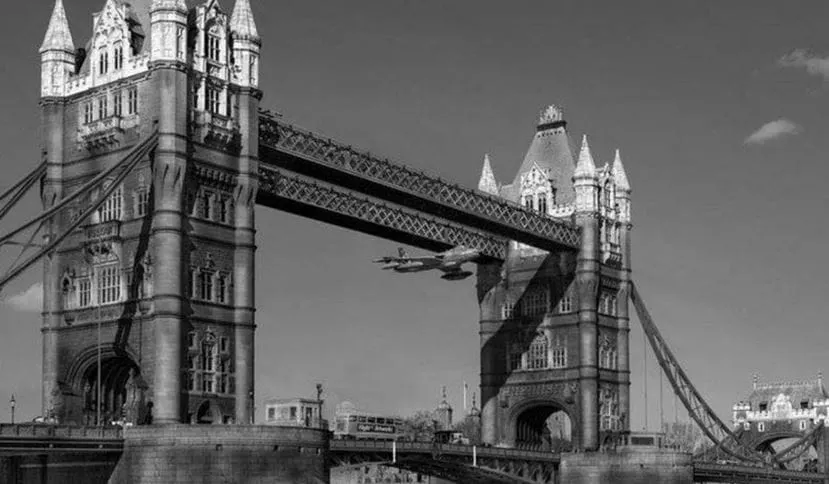
A quick fuel check told him it was time to leave so he continued down river to make an exit to the east before turning north to climb and head for West Raynham. Passing Waterloo bridge, he could make out the splendour of St Paul’s Cathedral and there, just beyond it, were The Tower of London and Tower Bridge. He was taken by surprise as a “target of opportunity” (more fighter-pilot speak) presented itself. He had just a few seconds to assess his situation and decide – over it? Or through it?
This is where the whole escapade might have gone horribly wrong. He could see a London bus crossing the bridge and decided he should err towards the girder-work of the top span. Through he went, stone and metal all around, simultaneously fearing that he had ‘overcooked it’ and the top span would take the jet’s fin off. It didn’t. He was through and heading over the Isle of Dogs, Greenwich, then turning Northwards to fly over Hornchurch airfield (another Battle of Britain aerodrome) and on over the Essex countryside towards Clacton before turning again towards North Norfolk, ‘beating up’ RAF Wattisham, RAF Lakenheath (a USAF base) and RAF Marham on the way.
On arrival at RAF West Raynham with just a few hundred pounds of fuel remaining, he made a low, inverted run over the squadron hangar before rolling right way up, turning into the traffic circuit and lowering the undercarriage and flaps for landing. As the jet rolled down the runway, the brake parachute bobbing behind, he had time to start thinking about what sort of reception committee might be waiting for him and how many flying regulations he had broken (just about all of them, I’d venture, and a few more besides).
On climbing out of his jet, he asked the airman who had met it to retrieve his overnight bag from the radio bay and took the opportunity to walk into operations, get hold of some matches and set fire to his maps. Next, he made some calls to his family to warn them about what might be about to happen before heading for the squadron offices where he encountered his squadron commander, the Wing Commander Operations Wing and the station commander, all of whom seemed to be rather cool about the whole affair and it was left to Pollock himself to suggest that perhaps they ought to place him under arrest!
To cut the story short, he wasn’t court-martialled (he should have been) but his flying days were definitely over. He was instead found to be ‘medically unfit for further service’ for a combination of obscure reasons and he was discharged on medical grounds which at least meant that he kept his Service Pension.
In truth there had been a lot of ‘behind the scenes politicking’ because he had garnered a significant amount of public support and even some journalistic and political support. A large number of people thought he had done just what they would expect their expensively trained fighter pilots to do!


He received hundreds of supportive letters from members of the public and other serving and former serving officers of all three services. Besides, he wasn’t the first pilot to fly an aircraft through Tower Bridge; he was, in fact, the fifth. He was just the first – and probably the last – to do it in a jet fighter.


Not everyone felt the same. The Voice of Authority:


Al Pollock’s feat was immortalised in oil by the aviation artist Michael Rondot, himself a former RAF fighter pilot with whom I was acquainted at one time.

Despite the passing of years, Pollock himself recalled the day clearly during this short video recorded for the 50th anniversary of the event by ITV News.
“Doing bridges” was a bit of a tradition in the RAF, once upon a time, as this letter to Flight International in the week after the event testifies.

Was the ultimate ‘bridge job’ the one done in 1988 by Ray Hanna under the Winston bridge over the River Tees in a Spitfire for the ITV series A Piece of Cake? It was certainly a daring, risk-laden and highly skilled piece of flying – a bit more than a “piece of cake” – that few pilots could seriously contemplate attempting.

Ray Hanna, renowned for many low-flying and aerobatic feats in “warbirds” had been the first leader of the Red Arrows. It was he who created the nine-aircraft show team that the world has enjoyed since 1965. He and Alan Pollock would have known each other as both were involved in RAF display flying at the same time.
Ray’s daughter Sarah describes in this video how her father went about accomplishing the feat for the cameras.
However, I think the prize has to go to Captain Eric “Winkle” Brown RN, test pilot extraordinaire, who in the course of a remarkable career carried out more deck landings on aircraft carriers (2,407) in more different types of aircraft (487) than any other pilot in the world. Ever. It’s a record that will never be beaten. “Winkle” was based at RNAS Arbroath just after World War II and one day, out with a Seafire (a navalised Spitfire) he flew under the Forth Bridge. Not only did he fly under it, he did it as a part of a loop; not only did he do it as a part of a loop, he did it three times in succession – one for each span of the red-girdered railway bridge! He later repeated the feat in a RN jet fighter, a DH Sea Vixen – but not as a part of a looping manoeuvre.

I must point out before I’m asked in the comments that in all of my 19 years flying in the RAF (1970–1989) I never did anything like it, not even during my carefully planned last flight in a Tornado. No airline would have employed me.
Flight Lieutenant Alan Richard Pollock slipp’d the surly bonds of earth to dance the skies on laughter silver’d wings on 1st July 2025. His obituary published in the Daily Telegraph is here.
This article was originally published by the Free Speech Backlash.