Nigel
Nigel is the founder, editor-in-chief, and lead writer at Pavlova Post, a New Zealand satire publication covering national news, local chaos, weather drama, politics, transport mishaps, and everyday Kiwi life – usually with a generous layer of exaggeration.
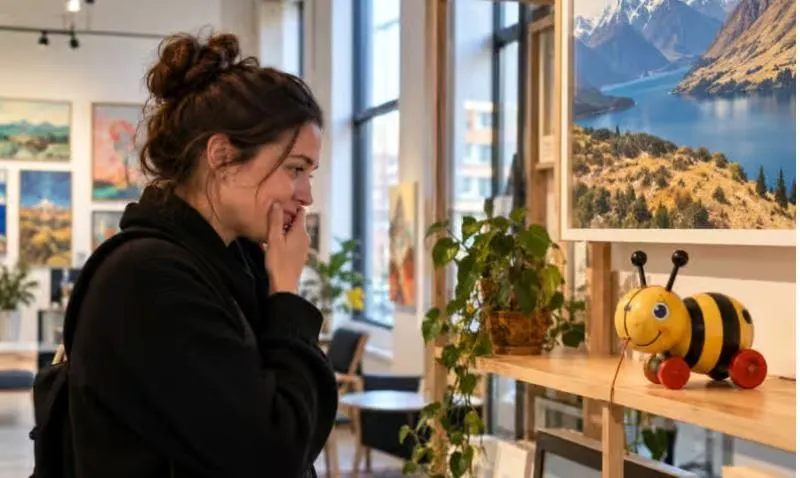
New Zealanders living in London appear to have discovered the minimum viable homeland: one Buzzy Bee, a decent view of Lake Wakatipu and enough familiar artwork to emotionally ambush somebody who had otherwise been coping perfectly well with Britain.
The Homegrown exhibition at Ten Four LDN in Angel brings together work from 27 artists living around the UK, including 23 New Zealanders and four Australians. Running until Christmas Eve, it has been described as creating a home-away-from-home feeling for the Kiwi community, which suggests our national identity may require considerably less floor space than previously thought.
Apparently you do not need the whole country. You just need to install enough New Zealand in one room that somebody walks in, spots a childhood object and immediately remembers a lounge carpet last seen in 1997.
Buzzy Bee has been promoted to cultural ambassador
Of all the objects capable of representing New Zealand overseas, the Buzzy Bee continues to punch absurdly above its weight.
It is a wooden pull-along toy with wheels and the sort of clacking mechanism specifically engineered to let parents know a toddler is approaching before visual contact has been established. Yet Te Papa describes it as an icon of Kiwi identity, and examples of the toy stretch back to the early 1940s.
That makes the Buzzy Bee considerably more experienced in international cultural relations than its job description would suggest.
A conventional ambassador needs an embassy, diplomatic credentials and several carefully worded statements. A Buzzy Bee just needs to sit there looking familiar until a New Zealander walks past and says, “Bloody hell, we had one of those.”
Mission accomplished.
The emotional response makes sense because nostalgia is rarely triggered by the objects anybody officially appoints to represent a country. A flag might remind you where you are from, but an old toy can suddenly remind you exactly what the floor looked like in the house where you were four.
That is considerably harder to defend against.
Homesickness does not follow the tourism brochure
The exhibition also includes Sarah Jane Moon’s Maybe Tomorrow, created during London’s first Covid lockdown while she was living in a basement flat without access to outdoor space. The work depicts the Moon looking out over Lake Wakatipu and grew from her longing for New Zealand’s open spaces.
That is where homesickness becomes unfair.
You can successfully adapt to another country, learn the transport system, locate acceptable coffee and become comfortable enough with the local supermarket that you no longer stare at the shelves like immigration has made an administrative error. Then somebody puts a familiar South Island landscape in front of you and several years of emotional stability disappear before lunch.
The things people miss are rarely organised enough to match a tourism campaign anyway. Somebody might miss Fiordland or Aoraki, but they might equally miss the crappy dairy near their old house, the smell of wet grass after summer rain, a particular beach car park or the strangely specific sound of a screen door at their grandparents’ place.
Distance is extremely good at promoting ordinary rubbish.
A battered biscuit tin becomes family history. An old rugby cap becomes an heirloom. The chilly bin with the damaged handle that nobody wanted to throw away becomes an important cultural artefact approximately four months after you move to England.
New Zealand now needs an official emergency kit
If Homegrown has established that a Buzzy Bee and the right scenery can reduce homesickness, Pavlova Post believes the obvious next step is standardisation.
Every Kiwi moving overseas should be issued one Emergency New Zealand Kit at departure. Contents would depend on generation, but there should probably be an Edmonds cookbook that nobody is required to open, one jandal whose partner vanished years ago, a faded tea towel depicting somewhere scenic, and a biscuit tin containing sewing equipment instead of anything remotely edible.
An unnecessarily large container of something from Mum’s pantry would provide weight and realism.
There should also be one item whose emotional significance cannot possibly be explained to a foreign flatmate. Ideally the explanation begins with, “Nah, you sort of had to grow up with it,” and lasts long enough that everybody regrets asking.
The kit would not contain polished symbols of national identity. Those are too obvious. It would contain the things New Zealanders barely notice while they are here and become strangely protective of the moment somebody overseas asks why they matter.
Our culture is apparently stored in the junk drawer.
London has accidentally completed the experiment
The people involved in Homegrown say the exhibition has created genuine connection. Zuru project executive Saba Haghi told 1News that surrounding the building with New Zealand art had reduced her homesickness, while NZ Art Club founder Luana Asiata described the opening as an opportunity for artists to connect with one another.
That is the serious heart of the story. Living overseas can make familiar references unexpectedly valuable, and an exhibition built by people with those shared references gives them somewhere to reconnect.
It is just extremely funny that one of the objects carrying part of that cultural workload is a wooden bee on wheels.
British colleagues may see an interesting New Zealand toy. Kiwis see childhood, relatives, old houses, noisy wooden floors and the possibility that one is still sitting in a cupboard at Mum’s place beneath several things nobody has touched since the Clark government.
The exhibition runs until 24 December, giving London-based New Zealanders plenty of time to inspect the country’s newly discovered minimum infrastructure requirements.
Twenty-three Kiwi artists have supplied the culture. Lake Wakatipu has supplied the scenery.
And one small wooden bee has somehow been left in charge of border control.
Grown-Up Links
- 1News – Buzzy Bee and Lake Wakatipu bring taste of home to Kiwis in London
- NZ Art Club – Homegrown exhibition and artists
- Te Papa – Buzzy Bee history collection record
This article was originally published by Pavlova Post.