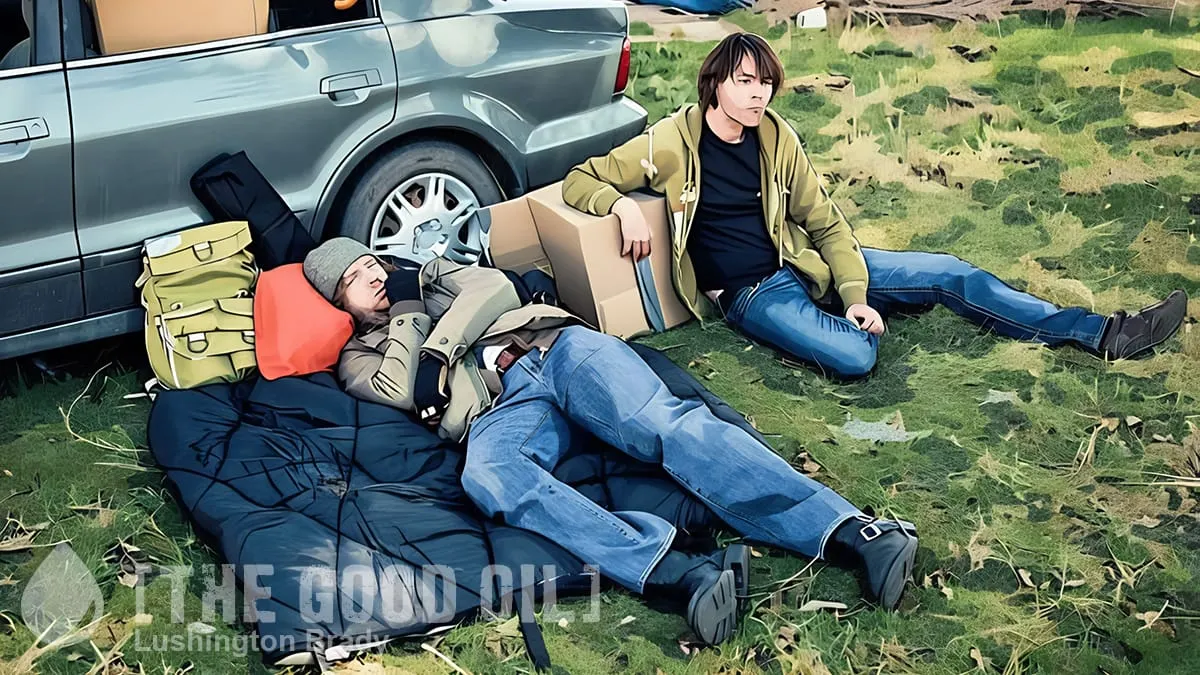
A standard rejoinder from Boomers whenever young people justifiably complain about the housing affordability crisis, is to pontificate about ‘back in our day, we paid 18 per cent interest rates’. That is true enough, but it ignores that 18 per cent of bugger-all is still bugger-all. House prices were so cheap that, at the peak of interest rates in the ’80s, housing was still vastly more affordable than it is today.
Today, house prices are so astronomical that even the standard deposit of 20 per cent far exceeds the median house price of the 1980s. Even in Sydney, then the most expensive city in Australia, the median house price was only 40 per cent of a median deposit today.
Young Australians are being asked to pay in full for two-and-a-half 1980s houses, just as a deposit.
Governments, with their usual outsized opinion of their own capabilities, have ‘helped’ with five per cent deposit schemes, which has only locked young people into debt traps.
The super-sized mortgages Australians need to buy into the property market have left most borrowers weighed down by interest bills even larger than when official interest rates were almost 20 per cent, new research of the housing sector has revealed.
Thanks to yet more ‘government help’ that now sees them paying off loans far in excess of what their houses are becoming worth.
They’d have been better off going to a ‘payday lender’ loan shark.
As the federal government faces accusations from the coalition that changes to property taxes are driving down home values, analysis by KPMG shows Australians are being forced to devote near-record levels of their income to servicing the interest bill on their mortgages.
The research lays it out in stark terms. The average mortgage now sits at $735,000, up $75,000 in a single year. In NSW it has hit $860,000. Households shelled out $33.6 billion in mortgage interest in the first quarter alone. Borrowers are now devoting 5.4 per cent of their income to interest payments – higher than during the late 1980s horror show of 17.5 per cent rates.
KPMG senior economist Terry Rawnsley said […] “The 17–18 per cent interest rate period of the late ’80s and early ’90s is often cited as the historical peak for home loan stress, but the data shows that borrowers have actually faced tougher conditions over the past few years.”
The Albanese government’s tax changes, dressed up as ‘intergenerational equity’, seeks with typical socialist envy to punish investors, which only reduces supply. Any economist could tell them what would happen next.
Prices are wobbling, but the debt mountain keeps growing. CoreLogic data shows national dwelling values slipped 0.4 per cent in June. Sydney and Melbourne face further corrections, yet even a 10 per cent fall leaves most owners in the black while locking out the next generation.
This is the bitter harvest of decades of policy failure and, most especially, the addiction to mass immigration without matching housing supply. The RBA has been warning for years that immigration-driven demand is the real pressure cooker. Yet Canberra keeps the taps wide open.
“Paying off a home loan has traditionally been a source of financial security. But increasingly, it is becoming a source of financial anxiety as repayment pressures rise again.”
Super-sized mortgages, even at today’s much lower rates, turn the Australian dream into a lifelong millstone. Young people are told to study harder, work harder and delay family formation, all while governments import hundreds of thousands more competitors for the same scarce stock of homes.
The coalition rightly points out Labor’s tax tinkering is spooking the market. But the deeper problem is structural. Until Canberra confronts the sacred cows – planning reform, migration realism and ditching the net-zero fantasies that make building anything expensive and slow – the young will keep paying through the nose for the privilege of renting forever or inheriting debt.
A generation is being priced out of the future their parents took for granted. And the political class, Labor especially, keeps offering band aids on a compound fracture.