Ashley Church
Digital creator
Back in June, I published an article titled The Prophecy of Catastrophic Climate Change: 50 Years of Failed Predictions.
It wasn’t an argument that the climate never changes, but rather an exposé of the more than half a century of warnings of climate catastrophe that failed to come true.
We were told that cities would disappear beneath the sea, islands would vanish, children would grow up without ever seeing snow, famine would spread across the planet, hurricanes would become increasingly frequent and destructive and entire nations would become uninhabitable.
The deadlines came and went and the catastrophes didn’t happen. In fact, none of those predictions came even close to being true.
Four days later, I published another article titled Was There Ever a Palestinian Nation?, explaining that Palestine had never existed as an independent nation. A large number of people shared it, including an American man whose repost happened to appear in my Facebook feed. Among the comments on his repost was one from a woman who was obviously his daughter, chiding him for sharing my article.
Not because of anything in the Palestinian article that he had shared, but because of the climate article I had published a few days earlier.
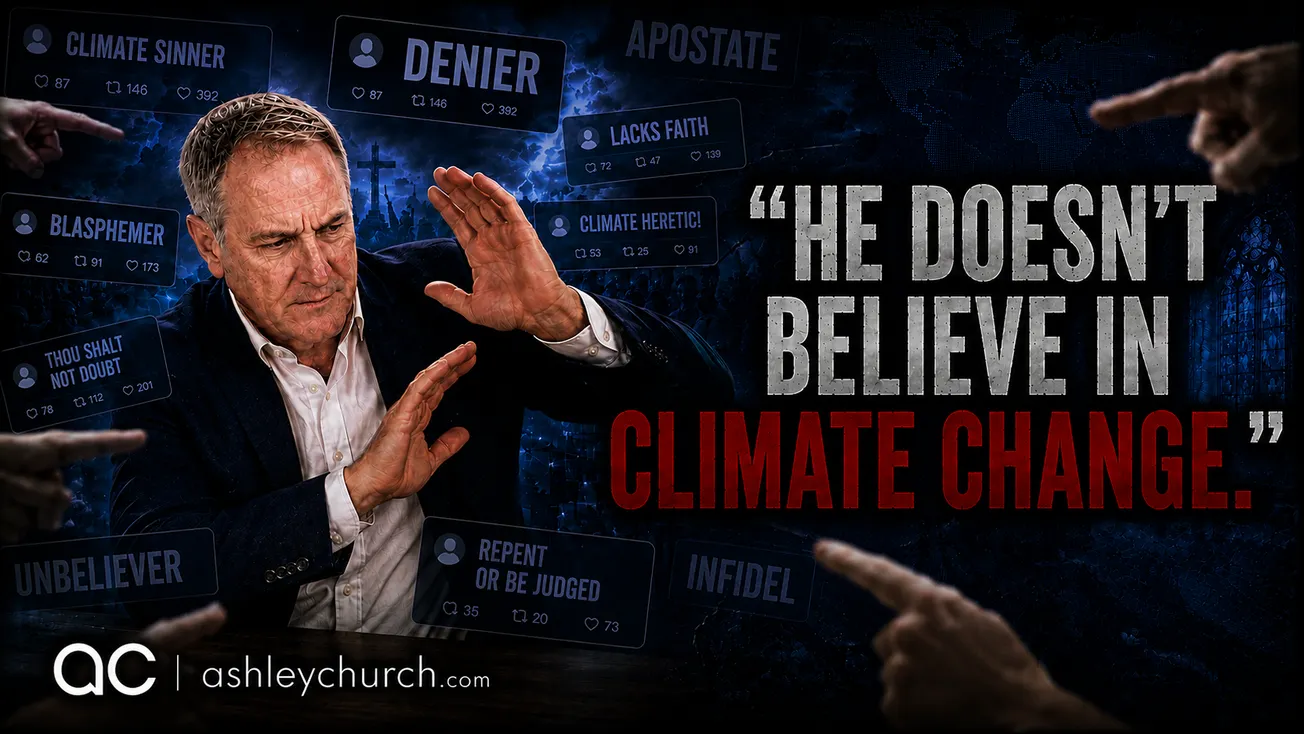
Her objection was simple: “He doesn’t believe in climate change.”
That was it. She didn’t challenge anything I had written about ‘Palestine’. She didn’t identify a factual error. Instead, she was criticising her father for sharing something I had written because I had apparently failed an entirely unrelated test of ideological purity.
But the most revealing word was “believe.”
People increasingly speak about climate change as something you either believe in or don’t. They rarely ask which particular claim you accept, what the empirical evidence shows, whether the models have performed accurately, whether a prediction has come true, or whether a proposed policy will make any meaningful difference.
You are simply a believer or an unbeliever.
That’s the language of religion, not science.
Science is supposed to involve observation, testing, disagreement and revision. Yet the climate movement increasingly has the characteristics of a faith system where, to question a forecast, challenge a model, doubt the wisdom of net zero, or ask what a policy will actually achieve, will quickly get you labelled a ‘denier’ – a word designed to end discussion rather than advance it.
But if we’re going to describe this as a kind of religion, it’s worth being very clear about what its central claim actually is. It’s not that the climate changes. It does. Nor is it simply that increasing carbon emissions have contributed to warming. They have. No, the climate religion is built on the ‘belief’ that we’re facing a ‘climate emergency’, and that unless we urgently reduce emissions the world will soon experience ‘catastrophe’ on an unimaginable scale.
But is that true?
Fortunately, we have something tangible against which to test that claim: the experience of the last century.
Over that period carbon emissions increased enormously, the world warmed, and human activity contributed to that warming. No debate there. But if the catastrophic proposition is broadly right, this ought to be the period in which we can see the consequences most clearly.
So let’s review what actually happened.
At the beginning of the last century, the global population was around 1.6 billion people. Today it’s more than eight billion.
Over that same broad period, the world economy expanded by something in the order of 25 times. Global life expectancy rose from the low 30s to more than 70 years. Modern agriculture learned to feed billions more people, while medicine, transport, communications and housing improved beyond anything our ancestors could have imagined.
And deaths from weather-related disasters collapsed.
Yes, you read that correctly. Despite the world having roughly five times as many people, the death rate from storms, floods, droughts and other natural disasters fell by more than 90 per cent.
That didn’t happen because nature became kinder. It happened because human beings became wealthier, more technologically advanced and more resilient. Reliable and affordable energy allowed us to build stronger homes, heat and cool them, power hospitals, forecast weather, irrigate crops, construct flood defences, operate emergency services and deliver food and medicine after disasters.
These developments happened because human beings innovated. Engineers built better infrastructure. Scientists and doctors developed new technologies and medicines. Farmers found better ways to produce food. Entrepreneurs created products and systems that transformed the way we live. Weather forecasting improved. Communications improved. Buildings became stronger. Transport became faster and more reliable. Energy became more widely available.
In other words, humanity became better at dealing with the world as it actually exists and the same abundant energy now described as humanity’s great enemy was one of the main tools through which we became safer.
And there’s another important point. None of these extraordinary advances happened because of the intervention of international climate bureaucracies. Despite the creation of enormous international bureaucratic structures to regulate emissions, move money around, trade carbon credits, set targets and hold endless conferences – global emissions continued to rise anyway – and human innovation, technology, and increasing wealth allowed us to adapt.
That doesn’t prove that warming caused human progress. It didn’t. But it does show that modest warming didn’t prevent humanity from flourishing.
So if rising emissions are supposed to be the harbinger of catastrophe, why does the historical record look so different from the catastrophe we’ve repeatedly been warned about? Wiser leadership would have seen us deal with climate change in its historical context – but, instead, the political response has moved in precisely the opposite direction. Rather than becoming more cautious about claims of catastrophe, governments have embedded them ever more deeply into public policy. And that’s why this is a religion with very real consequences.
Its doctrines have been embedded in law and used to restructure energy, transport, agriculture, industry and international trade. Governments have imposed emissions trading schemes, carbon taxes, renewable-energy mandates, restrictions on fossil fuels, subsidies, penalties and net-zero targets.
Direct carbon pricing now covers close to 30 per cent of global greenhouse-gas emissions and raises more than US$100 billion a year. Those costs don’t remain with electricity generators, fuel suppliers or industrial producers. They work their way through power prices, fuel, freight, food, heating, construction and almost everything else a modern economy produces.
Britain now has some of the highest industrial electricity prices in the developed world. New Zealand and Australia impose costs on farmers, motorists, businesses and industries despite producing only a tiny share of global emissions and having no measurable influence on global temperature.
Fortunately, however, political reality is beginning to intrude. Canada has scrapped its federal consumer carbon charge. European governments have delayed or softened parts of their climate programmes as the effect on household bills and industrial competitiveness has become harder to ignore. Britain has delayed net-zero measures. Scotland abandoned its 2030 emissions target after being told it was no longer credible. New Zealand has reversed restrictions on offshore oil and gas exploration.
This isn’t yet a wholesale international retreat. The climate bureaucracy remains deeply entrenched. But the cracks are becoming visible.
Oh, and by the way – even the ‘untouchable’ climate models themselves are being revised. For years we were repeatedly told that ‘the science was settled’, but the assumptions behind the most extreme projections are now being pulled back.
RCP8.5 and its successor SSP5-8.5, which assumed extraordinary growth in fossil-fuel use and underpinned many of the most alarming predictions of the past decade, are no longer being treated as plausible and those estimates have been dropped from the new CMIP7 framework and replaced with a lower high-emissions scenario. Put simply, some of the assumptions that drove the most frightening projections have now been abandoned.
That extreme pathway supplied much of the fear that made increasingly severe emissions targets, carbon taxes, net-zero laws and trading schemes politically acceptable. Yet despite these nonsensical projections now being abandoned, the machinery created in their shadow remains firmly in place.
Governments revise the forecast, but they never volunteer to repeal the costs imposed in its name.
This is how uncertainty becomes certainty. A model produces a range. A report emphasises the frightening end. A politician removes the qualifications. A journalist writes the headline. By the time the claim reaches the public, a speculative scenario has become something that scientists say ‘will happen’.
And then we teach that fear to children.
I recently watched a YouTube clip of a young girl of perhaps 12 or 13 saying that she expected to be killed by climate change. Think about that. A child has been taught to believe that climate change is personally coming to kill her. That isn’t education. It is psychological abuse.
Children should be taught how to examine evidence, understand uncertainty and appreciate the extraordinary ability of human beings to solve problems. Instead, many are being taught that catastrophe is certain, that their future has already been destroyed and that questioning this fatalism is immoral.
We have given them anxiety instead of agency and fear instead of facts.
So let’s be clear. Environmental stewardship matters. We should reduce genuine pollution, use resources wisely and protect people from real risks. But that doesn’t require us to accept the predictions of a bloated bureaucracy that acts as the high priesthood of a new age religion.
We would achieve far more by investing in flood protection, secure water supplies, resilient infrastructure, emergency planning and reliable energy than by pretending politicians can fine-tune the global temperature.
The climate changes. Human beings influence it. But those statements are not a blank cheque.
They don’t oblige us to accept apocalyptic predictions that repeatedly fail. They don’t require us to impose enormous economic costs for outcomes that can’t be measured. And they certainly don’t justify dismissing someone’s argument about Palestine because he has failed an unrelated test of climate faith.
The woman who wrote “he doesn’t believe in climate change” probably thought she was defending science.
In reality, she demonstrated just how successfully real science has been replaced by belief.
This article was originally published by ashleychurch.com.