Greg Bouwer
IINZ
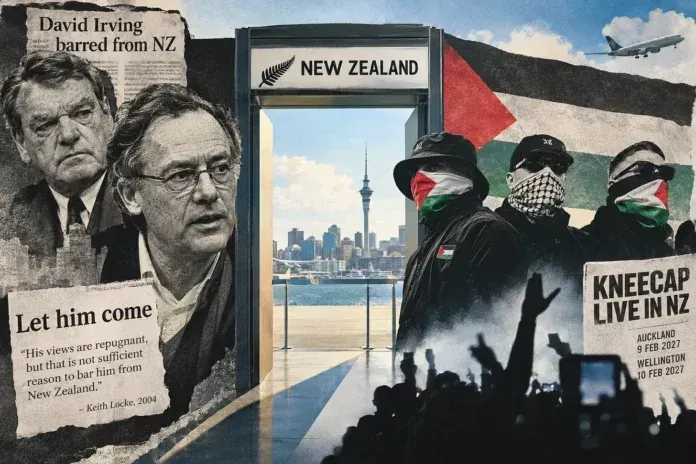
New Zealand has decided to allow Kneecap to return despite controversy over Hamas and Hezbollah. Twenty-two years ago, Green MP Keith Locke defended the right of Holocaust denier David Irving to enter New Zealand while unequivocally condemning his views. That combination of free expression and moral clarity is worth recovering.
In 2004, New Zealand faced an argument about whether an inflammatory foreign visitor should be allowed into the country.
David Irving wanted to come here. Irving was a Holocaust denier whose views were deeply offensive to New Zealand’s Jewish community. Immigration authorities decided he should not be admitted, relying on his previous deportation from Canada.
One of the politicians who objected was Green MP Keith Locke. But Locke did something that seems increasingly difficult in contemporary politics. He defended Irving’s freedom without defending Irving.
“David Irving’s Holocaust denial views are repugnant to most New Zealanders,” Locke said, “but that is not sufficient reason to bar him from New Zealand.”
He described Irving’s analysis as “fatally flawed” and his views as “obnoxious”. Banning him, Locke argued, would simply give those views more publicity.
A few days later, Locke developed the argument under an admirably straightforward heading:
Let Him Come.
Again, there was no ambiguity about what he thought of Irving. His Holocaust views, Locke wrote, were “hurtful to the Jewish community and repugnant to any decent New Zealander”.
Locke was hardly an uncritical supporter of Israel. He was a sharp and persistent critic of Israeli policy and spoke publicly in support of the Palestinian cause. That makes his position here more instructive, not less. His hostility to aspects of Israeli policy did not prevent him from recognising Holocaust denial for what it was.
Nor did his defence of Irving’s freedom reflect indifference to antisemitism. During the same period, when more than 90 Jewish graves were desecrated in Wellington and a Jewish chapel was damaged by fire, Locke condemned the attacks as racist persecution and expressed solidarity with the Jewish community.
He was capable, in other words, of holding several ideas simultaneously.
- Holocaust denial was repugnant.
- Antisemitic attacks required unequivocal condemnation.
- David Irving should still be allowed to speak.
There was no contradiction.
Twenty-two years later, another controversial group is coming to New Zealand. This time it is Kneecap. And Keith Locke’s principle deserves another hearing.
Kneecap is coming
The Belfast rap trio are scheduled to perform in Auckland on 9 February and Wellington on 10 February 2027.
The immigration question has already been decided. All three members have been granted visas following a Special Direction allowing their applications to be considered despite their status as excluded persons.
That status arose after Hungary banned Kneecap for three years in 2025, with Hungarian authorities arguing that their presence posed a national-security threat. Under New Zealand immigration law, exclusion from another country can trigger our own excluded-person provisions.
So New Zealand did not simply wave Kneecap through.
The legal machinery was engaged. Their circumstances, immigration histories and potential risk to New Zealand were considered. A Special Direction was granted, allowing visas to be issued.
We think that was the right decision. Not because Kneecap deserves admiration. Far from it.
But because the Greens of Keith Locke’s generation understood something worth preserving:
Defending someone’s freedom to speak does not require pretending that what they say is acceptable.
Permission is not endorsement
Kneecap have built a public identity around provocation, Irish republicanism and, increasingly, aggressive activism over Israel and the Palestinians.
The most serious controversy involved Liam Óg Ó hAnnaidh, known as Mo Chara, who was charged in Britain after allegedly displaying a Hezbollah flag during a London concert in November 2024 in circumstances prosecutors said indicated support for the proscribed organisation.
That case is now over. The charge was dismissed in September 2025 because the proceedings had not been lawfully instituted within the required timeframe. In March this year, Britain’s High Court rejected the prosecution’s appeal.
That outcome needs to be stated accurately. Ó hAnnaidh was not convicted. But neither did a court acquit him after determining the truth of the underlying allegation. As the High Court itself made clear, he “has not been convicted, and he has not been acquitted”. The case ended because the court lacked jurisdiction to try it.
Kneecap denies supporting Hamas or Hezbollah. They argue that their position is one of solidarity with Palestinians and opposition to Israeli conduct, and that accusations of terrorist sympathies misrepresent them.
People can examine the record and judge that defence for themselves. But for New Zealand, one fact should be straightforward. Hamas and Hezbollah are designated terrorist entities here.
Whatever one’s view of Israel, Palestinian statehood, settlements, Gaza or Benjamin Netanyahu, neither Hamas nor Hezbollah should be romanticised as fashionable symbols of rebellion. Yet that does not mean the state should silence people who do so.
Immigration New Zealand made the necessary distinction particularly clearly when explaining the Kneecap decision. There is no provision allowing entry to be refused solely because of someone’s political views or opinions, and granting a visa does not constitute endorsement of those views, opinions or activities.
Exactly. A visa is permission to cross a border. It is not a certificate of good character.
The law was tested – and applied
This matters because Kneecap was not an easy immigration case. Their Hungarian exclusion meant New Zealand’s statutory provisions actually had work to do.
The Immigration Act provides mechanisms for dealing with people who would otherwise be excluded from New Zealand. It also provides a mechanism – a Special Direction – through which such cases can nevertheless be considered on their individual circumstances.
That is what happened.
One can disagree with Immigration New Zealand’s assessment. But there is an important difference between arguing that officials incorrectly applied an existing legal threshold and demanding that a new political threshold be invented because the applicants are offensive.
New Zealand should be extremely reluctant to do the latter.
Many Israelis, Zionists and Jewish speakers have discovered how quickly the language of “safety”, “extremism” and “harm” can be turned against them. Pro-Israel events have faced demands for cancellation. Speakers have been protested and disrupted. Zionism itself is increasingly described in some activist circles not as a political position to be debated but as something that should be denied a platform.
Those who value freedom of expression cannot credibly demand expansive protections for speakers they agree with while demanding state exclusion for speakers they despise.
The precedent will not remain ours to control.
Keith Locke understood the difference
This is what makes the Green Party’s own history so instructive.
Locke did not respond to David Irving by saying Holocaust denial was complicated. He did not excuse Irving because some of his other historical opinions might be legitimate. He did not insist critics were taking him out of context. And he certainly did not celebrate him.
He said his views were repugnant. Then he defended his freedom. Those positions strengthened rather than contradicted one another. Locke’s defence of free expression had credibility precisely because he applied it to someone whose ideas he despised.
That is what a principle is. A principle that operates only when its application is comfortable is merely a preference. And this is where Locke’s example remains useful today.
The question should not merely be whether Kneecap is entitled to perform. They are coming. That decision has been made. The harder question is whether those who defend or celebrate Kneecap can show the same moral clarity Locke showed toward Irving.
Can they defend Kneecap’s freedom while saying unequivocally that Hamas and Hezbollah deserve no romanticisation?
Where is the second half of the principle?
There is no contradiction between supporting Palestinian rights and condemning Islamist terrorism.
That should barely need saying.
One can support Palestinian self-determination. One can condemn Israeli policies. One can oppose settlements. One can believe Palestinian civilians in Gaza have suffered terribly. One can believe Israel’s government has made grave mistakes.
And one can simultaneously say that Hamas and Hezbollah are terrorist organisations whose violence should not be romanticised, excused or transformed into countercultural theatre.
Indeed, maintaining that distinction ought to be essential to any credible movement for Palestinian rights.
The problem begins when condemnation becomes selective.
A simple test is to change the organisation.
If a fashionable musician displayed an ISIS flag, apparently praised al-Qaeda, or cultivated deliberate ambiguity around a violent white-supremacist movement, would politicians and activists treat the imagery as courageous, transgressive resistance?
Almost certainly not. Nor should they.
Yet Hamas and Hezbollah can occupy a strangely different cultural category. Their violence is filtered through a vocabulary of “resistance”, “decolonisation” and “liberation” that can make conduct regarded as intolerable elsewhere appear politically glamorous.
October 7 should have made the danger of that romanticism impossible to miss. Hamas-led terrorists deliberately attacked Israeli civilian communities, murdering and abducting people including children, elderly people and foreign nationals.
Hezbollah’s history is different but hardly more compatible with progressive romanticism. It is an Iranian-backed armed organisation that has operated beyond the control of the Lebanese state, engaged in terrorism and exercised enormous coercive power within Lebanon itself.
One can believe Palestinians have suffered grievously without making Hamas virtuous. One can condemn Israeli actions in Lebanon without making Hezbollah virtuous. That is the second half of Locke’s principle.
Defend the freedom. Then judge the ideas – consistently.
Don’t manufacture martyrs
There is another reason New Zealand was right to admit Kneecap.
Banning them would have been enormously useful to them.
Their brand thrives on confrontation with authority. Exclusion would instantly have changed the argument.
Instead of discussing what Kneecap have said, what symbols they have displayed and why terrorist organisations have become objects of fashionable ambiguity, we would be debating censorship.
They would become the rebellious artists New Zealand was frightened to hear.
Why give them that?
Kneecap has already performed here. They toured New Zealand in 2025. New Zealand survived.
Let them return. Let them perform, provided they obey New Zealand law. Let protesters stand peacefully outside. Let journalists challenge them. Let Jewish New Zealanders explain what Hamas did on October 7. Let Iranian dissidents and Lebanese opponents of Hezbollah explain what that organisation represents. Let Palestinians who oppose Hamas reject the claim that solidarity with their people requires romanticising the movement that rules Gaza.
And let people decide whether they want to buy a ticket. That is what freedom looks like. It includes Kneecap’s freedom to speak. It also includes everyone else’s freedom to tell them they are wrong.
Condemn without censoring
The current political argument provides a small but revealing illustration.
Kneecap recently waded into a thoroughly New Zealand dispute after Green MP Tamatha Paul’s comments about English and colonialism attracted international attention. The group publicly backed Paul.
Foreign Minister Winston Peters responded with characteristic restraint – which is to say, none.
He described Kneecap as “low IQ weasels who have no idea about history”, adding that his criticism applied to Paul too. Kneecap responded by inviting Peters to their concerts. The episode has nothing to do with Hamas or Hezbollah, and should not be made to carry that argument. But in its own slightly ridiculous way, it demonstrates something valuable.
A foreign band intervenes in New Zealand politics. The foreign minister condemns them. They mock him. They invite him to their show. And they are still allowed to come.
That is liberal democracy functioning rather well.
Nobody needs to be silenced. Nobody needs protection from hearing the exchange. Nobody needs to mistake tolerance for approval. There should be nothing partisan about that principle.
The political left should be capable of condemning Islamist terrorism without surrendering its concern for Palestinians.
The political right should be capable of defending freedom of expression without pretending every provocation is harmless.
Supporters of Israel should be capable of defending Kneecap’s freedom to perform while vigorously challenging what they say.
And supporters of Palestine should be capable of saying that neither Hamas nor Hezbollah represents the future they want for Palestinians.
Those positions are entirely compatible.
The real test is not at the border
Immigration New Zealand has now done its job. Kneecap can come.
The more interesting questions begin after they arrive.
- How many people will buy tickets simply because they like the music?
- How many will attend precisely because of the politics?
- How many regard Hamas or Hezbollah imagery as harmless provocation?
- How many understand what those organisations actually are?
And how many people occupying influential positions in politics, academia, media and culture will defend Kneecap’s freedom while also drawing an unambiguous boundary against the romanticisation of terrorism?
Those questions cannot be answered by Immigration New Zealand. They concern us.
A liberal society cannot be measured only by the opinions it permits. It is also revealed by the opinions its citizens choose to celebrate.
Let them come
Twenty-two years ago, Keith Locke offered New Zealand a difficult proposition.
Let David Irving come. Not because Holocaust denial deserved respect. Not because Irving’s ideas were harmless. Not because Jewish New Zealanders were wrong to be offended.
Locke thought the views were obnoxious, fatally flawed and repugnant. And still he said: let him come.
That position required two different virtues.
The confidence was in allowing Irving to speak, trusting that a free society did not need the state to protect it from his falsehoods.
The clarity was in refusing to confuse that freedom with approval. Irving could be allowed to speak and his ideas could still be called repugnant.
New Zealand needs both virtues now.
So let Kneecap come. Let them perform. Let their supporters cheer.
But let us also pay attention to what is being cheered – and whether the moral standards applied to other forms of extremism mysteriously disappear when the language of “resistance” is invoked.
Keith Locke’s old Green position offers a better standard. Defend the freedom. Condemn the extremism. Do both without qualification. Because the real measure of a free society is not merely whether it permits people with repugnant ideas to speak. It is whether the rest of us still have the moral confidence to call those ideas repugnant.
This article was originally published by the Israel Institute of New Zealand.