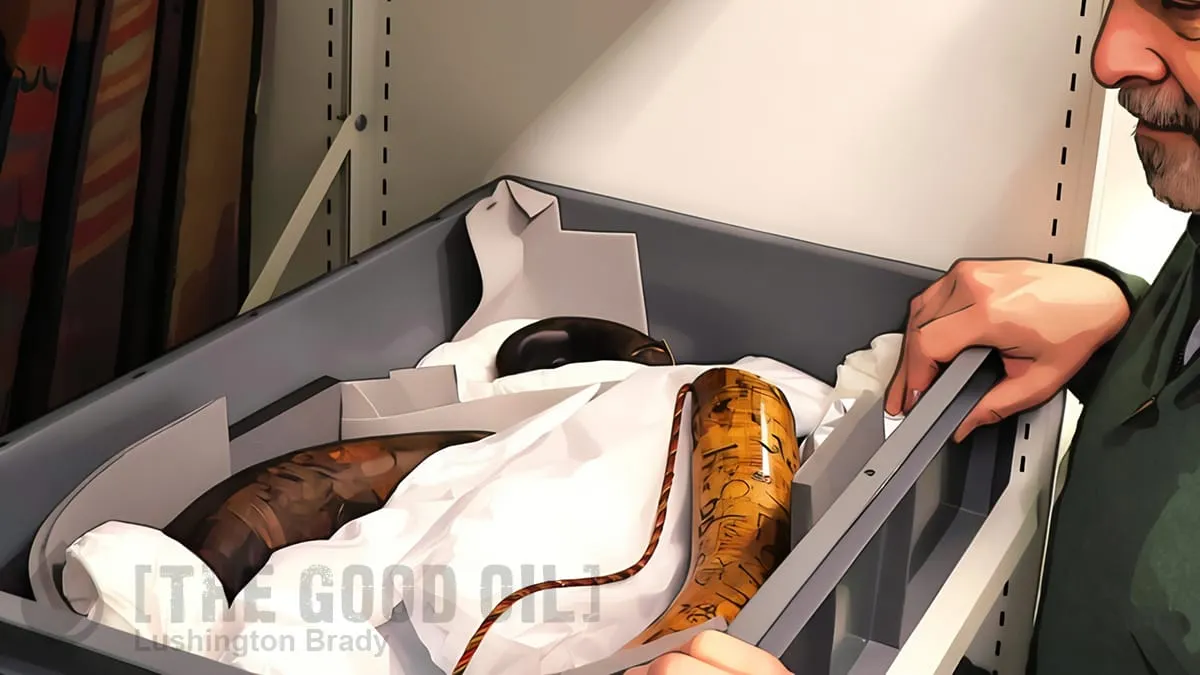
There has been a mania for years among Aboriginal activists in Australia to ‘repatriate’ remains collected by anthropologists over the past two centuries. The excuse given is ‘cos kulcha!’ But that’s more than a little hard to swallow, seeing a ragtag of pasty-pale, blonde-haired, blue-eyed types, who’d be poster children for the blut und boden lot if they were dressed in lederhosen rather than store-bought possum-skin cloaks, ‘bringing home our ancestors’.
We might be forgiven, though, for thinking there’s a far more sinister agenda afoot. These remains are, after all, scientifically invaluable as insights into pre-1788 Australia. Insights that, it seems, the Aboriginal Industry is not so keen on anyone noticing. As Stephen Webb’s The Paleopathology of Aboriginal Australia showed, for instance, pre-contact Australia was an astonishingly violent place. Especially for women. A high proportion of remains studied showed signs of trauma, especially head trauma. Women more so than men.
Best to squirrel the remains away in the dirt, far from the prying scientific gaze, then, before any more embarrassing skeletons literally come to light.
Ancient remains can also yield valuable DNA data. Data that, in the Americas for instance, is re-writing half a millennium of conventional wisdom. But not in a way the activists like.
The use of genetic data and genomics is revising down our estimates of the population of the pre-Columbian Americas and also providing new evidence of the role of diseases in the decimation of indigenous populations.
For more than a century, scholars have argued over the size of the indigenous population of the Americas on the eve of European contact […] The debate has always involved more than numbers.
Inflated pre-contact population figures have long been weaponised to paint European settlement as original sin and genocide. Ancient DNA is now exposing the numbers as rhetorical inventions rather than demographic reality.
Nowhere is the revision more stark than on Hispaniola, the first sustained point of contact in the New World. For generations historians parroted estimates of 250,000 to a million or more inhabitants in 1492, which was too-obviously a sales pitch from promoters of exploration and colonies, rather than hard fact. More problematically, these figures, drawn from the polemical writings of Bartolomé de las Casas, fed the Black Legend of uniquely Spanish cruelty and supplied the numerical foundation for modern ‘settler-colonial’ narratives.
Genomic evidence has demolished them. A 2020 study in Nature analysing ancient DNA from 174 individuals across the Caribbean concluded that the pre-contact population of Hispaniola was in the low tens of thousands, of the order of thirty thousand people.
The genomic evidence does not merely revise earlier estimates – it overturns them […]
The New York Times immediately grasped the significance of the finding, reporting that ancient DNA was “changing how we think about the Caribbean.” That is an understatement. The genomic evidence does not merely revise earlier estimates – it overturns them. It forces a fundamental rethinking of the demographic, social, and moral history of the first century of European colonization.
Most pointedly, it demolishes the narrative of a ‘genocide’. That an astonishing percentage of the indigenous population died is not at dispute. They did and it remains one of history’s great tragedies.
But genocide is not just a catchy protest slogan. It’s a real word, with a real and very specific meaning. Most critically, genocide requires intent. The settlers did not intend to wipe out the indigenes, whom, their contemporary writings make clear, they in fact greatly admired in many ways.
Disease, not Spanish sadism, was the primary killer. Smallpox, measles, influenza, and the hemorrhagic fevers known as cocolitzli or matlazáhuatl swept through populations with no prior exposure. The shock of conquest –war, famine, forced labor, and social disruption – made indigenous communities even more vulnerable.
These pandemics did the overwhelming bulk of the killing, exactly as they did in Europe during the Black Death, except Europe recovered and many indigenous societies did not. The Spaniards presided over a collapse of extraordinary severity, but they did not exterminate millions in any industrial genocidal sense. Recognising the true scale reframes the tragedy without diminishing its horror for the people who lived through it.
The Australian parallel is obvious. Pre-1788 populations were small, mobile and hunter-gatherers across a vast continent. The same activist class now demanding the reburial of skeletal collections is the same class that insists on a narrative of peaceful, harmonious custodianship shattered only by white invasion. The remains tell a grimmer story of routine violence, particularly against women. DNA analysis would likely reveal further awkward complexities about origins, admixture and population dynamics, exactly as it has in the Americas.
That is why the remains must be hurried back into the ground before inconvenient facts accumulate. Science is not the friend of myth-making. Once the bones are reinterred, the narrative is safe from further scrutiny.
Truth is the casualty, not culture.