Ani O’Brien
Like good faith disagreements and principled people. Dislike disingenuousness and Foucault. Care especially about women’s rights, justice, and democracy.
When a man approached the home of New Zealand First leader Winston Peters with a crowbar last year, Peters was not home. However, when the man shattered a window sending glass raining down on Kobe the black Labrador, Peters’ partner and a friend were inside. It is fair to assume the women were utterly terrified. The house had been surrounded for a few days by pro-Palestine activists chanting at times abusive and aggressive slogans. It was actual violence.
The surrounding news coverage and controversy gave us insight into both how the media frames violence against politicians when they aren’t from one of their favoured parties and the character of certain MPs. In particular, Green Party leader Chlöe Swarbrick. At a press conference at which the Greens hailed the bravery of a few idiotic New Zealanders who embarked on the futile and attention seeking mission to take a flotilla towards Gaza in an attempt to break Israel’s naval blockade, they lamented the supposed lack of action of the government in rescuing the activists once the Israeli authorities inevitably picked them up. The Greens were joined at the microphone by other pro-Palestine activists and Chlöe Swarbrick even introduced one, actress Acacia O’Connor, giving her the opportunity to speak to the media.
Acacia’s face was quickly identified as familiar by many watching as a woman who had filmed herself taking part in the harassment of Peters and his family outside their home days earlier. She had gleefully livestreamed from the Global Movement to Gaza Instagram account and repeatedly called for more people to join them, even disclosing Peters’ street address.
O’Connor had had a prominent role in One New Zealand’s flagship advertising campaign, but after her role in the harassment and violent rhetoric came to light the company dropped her.
Having been remarkably unfazed by the actions of Green Party supporters thus far, Swarbrick was unrepentant about platforming a person who was endangering the safety of another MP’s family. In fact, she asserted that the protestors, and specifically O’Connor, were being “bullied by some of the most powerful people in the country”. Despite later generally condemning violence and doxxing, she went to great pains to explain and justify the activists’ distress and defend their right to protest with no consideration for how she might feel if someone put a crowbar through her front window. She seemed to care little for the fear that Peters’ partner, and the friend who was there to support her, must have felt. She couldn’t even summon up concern for poor Kobe the dog.
That, my friends, is selective empathy.
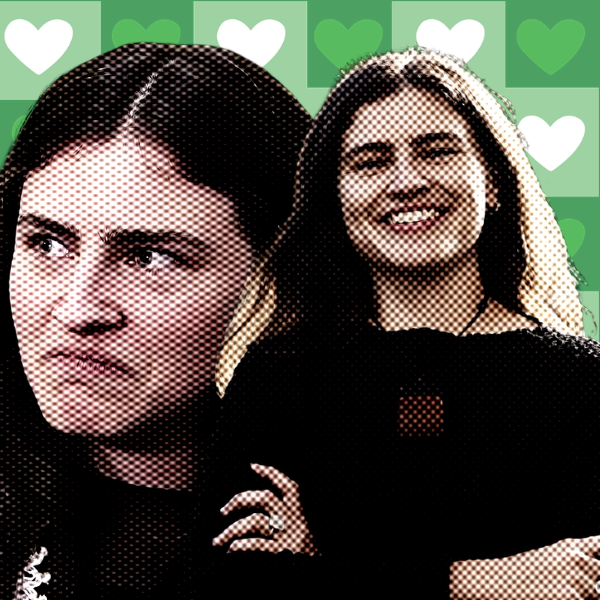
This week, however, Swarbrick is demanding the empathy of the media, her fellow politicians, and the New Zealand people as she claims that National is “effectively cyberbullying her”. The first of those groups is eagerly complying and pressuring the other two groups to similarly pander to the discomfort of the Greens’ co-leader. To be fair to Swarbrick, she has indeed been the focus of a lot of attention from the National Party this election campaign. But this is because the idea of her occupying a position of power in a Labour-led government scares the living crap out of a sizeable amount of New Zealanders. The National ads are responding to population fears, not creating them.
Nonetheless, Radio New Zealand reports in horror that 37 of National’s 94 Instagram posts over six days featured her or her party. Why featuring her party is even an issue I don’t know. Swarbrick has claimed the campaign is “nasty” and “hysterical”. She has claimed that Christopher Luxon is being the “mean girl” of New Zealand politics. Interestingly, these assertions are negatively female-coded. Imagine if the roles were reversed.
So yes, she is receiving a lot of attention. Most of it regarding her publicly and repeatedly stated ambitions to be finance minister. National has seized on the horror this thought inspires in many much like Labour has repeatedly “scaremongered” (as media have called National’s content) about David Seymour being finance minister if the coalition are returned. No accusations of bullying have been levelled there. But counting how many times an opponent mentions you at the pointy end of an election campaign does not establish bullying. Frankly, it is pathetic to assert it.
Politicians should not face the abuse I described at the outset of this essay. They should not be threatened with violence or have their family targeted. It is, on the other hand, very very normal for politicians to be criticised, lampooned, and scapegoated by opponents in the cut and thrust of politics. A party leader seeking power over the country’s finances is a legitimate matter for other parties to draw attention to, however unpleasant she might find their characterisations of her being unqualified and unsuited to the role.
In 2024, when questioned on Q&A about the direct correspondence a Jewish primary school had had with her regarding her rhetoric and behaviour at pro-Palestine rallies and alike, Swarbrick said of people sharing these concerns “perhaps that discomfort is something we should lean into”. Perhaps now would be a good time for her to do the same.
The problem is there is an obvious double standard with how our media treat politicians on the left and the right when it comes to matters regarding their personal safety, the aggressive and abusive rhetoric directed at them, and their feelings. The attack on Peters’ home received news coverage, but it was distinctly more cold in its presentation and did not turn it into an existential crisis about the treatment of government parties or centre-right politicians. In comparison, pretty banal election content (albeit intense in its repetitiveness) has garnered breathless commentary about unacceptability, cruelty, meanness, bullying, and so on.
Incredibly, media have even put it to the prime minister that the campaigning could be subject to action under the Harmful Digital Communications Act. Not only is this batshit insane, as it would create an appalling precedent that would make attacking the politics of one’s opponents virtually impossible, but it wound me right up personally. The media made me headline news, with push notification and all, because of my use of the same act against a man constantly harassing and abusing me in (what he claims is) New Zealand’s biggest left-wing blog. They cared not for my feelings and whether I had been bullied, printing some blatantly untrue things and generally dragging me through the mud. I actually accepted most of this as par for the course of being a somewhat (very insignificant) public figure. But what I do not accept is the way women labelled as right-wing, as I have been, are treated as fair game while left-wing women are babied and pandered to.
It is this phenomenon that saw Stuff journalist Andrea Vance call Finance Minister Nicola Willis and a handful of other female ministers “c***s” in her political column. The media rallied around to justify this as fair dinkum, she faced no sanctions, and even won a prestigious award not long afterwards. Let’s do the tiresome, but telling, exercise of imagining if Stuff columnist Damien Grant, for example, called Swarbrick and other left-wing MPs the same pejorative because he found their policies odious. What do you think would have been the reaction?
You may know that I worked for Judith Collins when she was leader of the opposition and given my access to her social media accounts I saw the daily abuse she received, much of it violent and misogynistic. The media never took any interest in this. But then Collins never complained either. Go look at any current female minister’s social media comments section. The abuse is there to see. The moral panic from the media is not.
The thing is, the left is portrayed by the establishment as the kind, compassionate, and empathetic end of the political system. The right is conversely cast as heartless and cold. Even some on the right imbibe this narrative, like National’s Tāmaki candidate Mahesh Muralidhar, who opined that Labour have more “heart” last week. And so, it is easier to depict the left as the good guys or the victims and the right as the bad guys or the perpetrators.
However, the left does not have a monopoly on empathy and I contend that in reality they are often not the kind side. They can be extraordinarily cruel and very selective about who they bestow their kindness and empathy upon. My contention is backed up by research. In a paper called ‘Empathic Conservatives and Moralizing Liberals: Political Intergroup Empathy Varies by Political Ideology and Is Explained by Moral Judgment’, the authors “examine barriers to cross-party empathy and explore when and why these differ for liberals and conservatives”. They conducted four studies involving 4,737 participants across the UK and the US and found reduced empathy towards the suffering of political opponents from both sides. However, conservatives consistently expressed more empathy towards liberals than vice versa. The difference, they concluded, was in large part due to liberals making much harsher moral judgements about their opponents and perceiving them as harmful and even existentially threatening. Conservatives tend to lean more towards seeing their opponents as stupid, misguided, or insane, things that are much easier to empathise with than evil is.
Some studies found somewhat different results, but, in these cases, the fine print is very important to take note of. A large German study called ‘Does a Left-Wing Political Orientation Really Go Along With Greater Prosociality? A Large-Scale Empirical Investigation’, found that left-wing people scored slightly higher in measures of concern for others. But, this was clearest in personality assessments where participants expressed empathy rather than the exercises in which they had to demonstrate it. It was, in a word, performative.
Performative empathy in itself can actually be a good and very necessary thing. It is how we signal to each other that we care about something and can be used to create social cohesion. Of course, it can do the opposite, but, if we look at the case of the terrible massacre on March 15th in Christchurch mosques, we can see an example where then-Prime Minister Jacinda Ardern used it to great positive effect. The country was in shock and struggling to make sense of the unprecedented violence and Muslim communities, particularly in Christchurch, were suffering immense grief. Ardern was able to convey the horror we felt and demonstrate the collective care for those impacted. She is very skilled at this kind of empathy and when she deployed it for good it was unifying.
But the ability to express feelings is necessarily only part of the responsibility of government and, I would argue, of being a decent human being. We all often have to weigh competing needs and interests and that can mean that empathy can become more complicated. This is acute in governance. A compassionate intention does not make up for an incompetent decision nor does a necessary but difficult decision mean there is no empathy.
The left seem to be the feelers and the right seem to be the doers. Both can be evidence of caring a great deal about the people of New Zealand and both are crucial parts of governing effectively. It is just very interesting that the feelers have successfully claimed the ground of being the ones who care when they can have very poor follow through in turning that care into action.
That care can also be weaponised to devastating consequences. There is an ugly and dangerous side to moral certainty when disagreement is recast as evil intent. Like when holding certain opinions results in a contamination effect where the holder is cast out from polite society as if their mere presence in their place of employment and community is a visceral risk. Fantasist Nicky Hager recently told media that it was his goal to see me and the others who featured in his defamatory book no longer welcome in polite society.
This has been dubbed Cancel Culture (capital Cs). It works by making a person’s continued employment or participation in society intolerable to those around them and, due to the pressure of the mob attack, to the person themselves. There are so many examples of this, like Dr Smylie, who I wrote about in my most recent A Week Is A Long Time wrap up. He now lives and practices medicine in Canada, having been hounded by the Medical Council for complaining about the use of te reo Māori, as he did not understand it, and mocking pronouns in bios. Or Cath Simpson, a nurse of 25 years, who was first suspended for two months by the Health Practitioners Disciplinary Tribunal and then sacked by Health New Zealand for posting on X about issues like abortion, immigration, and sex and gender. Unacceptable right-coded views, although some were no doubt inflammatory. Or the numerous times that activists contacted my employers over the years to try get me sacked. One former Labour minister only recently tracked down one of my clients to inform them of my gender critical views and urge them to drop me. They were aware of my views, unsurprisingly, and did not drop me.
Former Reserve Bank Governor and leader of the opposition Don Brash was banned from Massey University (incidentally I too have been banned from Massey along with three other women attempting to speak about the Births, Deaths, Marriages, and Relationships Registration (then) Bill). The Listener 7 dared to argue that mātauranga Māori had cultural and practical value but should not be treated as equivalent to science. They too faced the mob, institutional denunciation, and investigations. Jordan Peterson’s make-your-bed book 12 Rules for Life was even bizarrely withdrawn from Whitcoulls stores following March 15 2019. There are many more examples.
At its most dangerous, political righteousness serves to create permission for violence. It is something that I am acutely aware of given the nature of some of the communications I receive and after witnessing the violence of the mob at Albert Park in 2023. The recent assassination of conservative Charlie Kirk in the US and the deification of Luigi Mangione for assassinating a man for the simple fact he was a health insurance executive make this all the more real. There is a real and worrying increase in political extremism and violence perpetrated by the left. This is compounded if you take into account the way left-wing political organisations are allying with Islamic groups.
Of course, the right can be cruel as well and produce bullies and extremists. In recent history far-right extremism has been more prevalent, although the left-wing atrocities of the 20th century seem to be too regularly forgotten. I am not seeking to invert the circumstances and paint the right as the innocent victims and the left as the brutal perpetrators. My argument is that both sides have potential for empathy and cruelty even if they manifest in different ways. Political affiliation does not alone determine the capacity to be kind or to care. Nor does it magically make criticism of women misogynistic in one situation and fair game in another.
Returning to Albert Park in 2023, I still cannot believe what happened that day. The police abandoned us to a mob baying for blood. We were pushed, pulled, punched in the face, and I genuinely thought they might kill Kellie-Jay (Posie Parker). Then they danced and sang like a marauding conquering horde after battle. And our media portrayed it as a victory for kindness and empathy. Afterwards ACT deputy leader Brooke van Velden condemned the violence of that day and Chlöe Swarbrick called her remarks “cringy revisionist history” and the protest “peaceful”. She had no empathy for the women who had gathered to hear Parker speak and were set upon by those who wanted to prevent it. She showed no empathy for the grandmother who was assaulted by a 20-year-old man. Punched in the face. She and her supporters were gleeful about punishing their political opponents because they had decided we were fundamentally evil.
Nowhere has this characterisation been more evident than in the obsessive and aggressive pro-Palestine and anti-Israel activism Swarbrick has engaged in since October 7. She has screamed offensive chants at rallies where open antisemitism was expressed. She has painted any sympathy toward the Israelis who were slaughtered, raped, and kidnapped as evil hatred of the Palestinian people. Swarbrick has been quite capable of delivering personal condemnations and insults related to this. In August last year she was thrown out of parliament for her comments to coalition MPs and she is on video encouraging protesting crowds to target these MPs. Swarbrick has ignored pleas from the Jewish community to temper her rhetoric. She has continued to inflame tensions and shown very very little empathy towards a community that regularly has to have armed police outside of their schools due to threats.
Similarly, I wonder, where is her empathy when she gives as good as she gets (more in fact) in the House, screaming at her opponents so much that she is often pulled up by the speaker? Where is her empathy for victims of violent crime when she wears the merchandise of extremist group People Against Prisons Aotearoa, who literally want to abolish prisons? Where is the empathy she displays for public servants when shutting down industry destroys regional employment?
We are being asked to accept that Chlöe Swarbrick should not be subjected to negative scrutiny about her politics and their potential consequences. We are being told she is entitled to our empathy when others simply are not. She is a victim and in need of paternalistic interventions.
Thankfully in New Zealand we don’t have anything remotely like the savagery we see in politics elsewhere. Seriously, go watch the attack ads in the US mid-term elections currently on. They are brutal and personal. Both sides do “oppo” research on their opponents and will exploit any perceived weakness. The so-called attacks on Swarbrick basically amount to saying she is not qualified, would be an appalling finance minister, and New Zealanders should vote to avoid that happening. Yes, they have repeated the message a lot and yes they have used photos in which Swarbrick looks rather animated. But perhaps if she had spent less time rolling her eyes, lecturing us all, screaming at rallies, and losing control of her emotions there would be fewer photos for them choose from. They are highlighting who she is and enough New Zealanders view her negatively that it is an effective tactic.
Swarbrick is an expert in performative empathy and anger. She expresses intense emotions with ease and this gives an appearance of her caring deeply for the matter at hand. I actually think she does care deeply. She is genuine in her anxiety over climate change and the various social ills she focuses on. But her empathy is highly selective and rarely extended to those she disagrees with. Ironically, she pays a lot of lip service to extending understanding across the aisle but it is a talk she does not walk. She is sanctimonious, derisive, quick to anger, brittle, ideological, and entitled. Equally she is passionate, charismatic, intelligent, articulate, determined, and ambitious. As a politician, people will admire and loathe her for all of those traits, but it is a very strange expectation to think her opponents should focus on the positive.
While I don’t doubt that Swarbrick is authentic in her care for the causes she champions, I challenge the assumption that the intensity of her feelings and how she presents them makes her any more compassionate than those who disagree with her. An MP who quietly works with communities and performs empathy more practically is not less caring because they don’t shout about it from the rooftops.
Empathy is a much less impressive quality when it is reliably doled out to one’s friends and totally absent for those who don’t not pass ideological tests. It is less believable and harder to view positively when it is full bore for Palestine and absent for Jewish communities. Or available in spades for protestors, but not for a politician’s family when one of those protestors put a crowbar through their window. Or casts trans-identifying males as victims and women who don’t want men in their spaces as evil and intolerable.
Those on the right need to start actively rejecting the accepted narrative that their kindness and empathy is less than that on the left. They need to defend the fact that their care manifests in more active ways and with less talk. They need to make the case that it is possible for everyone in parliament to care about an issue and yet reach many different conclusions as to how to deal with it. The left do not have a monopoly on empathy.
This week we will choose the people to exercise power over us for the next three years. We deserve better than a manipulative and patronising attempt to prevent scrutiny of a party leader’s politics and behaviour. We are entitled to examine all of their judgement, test their promises, and come to whatever conclusions. The intentions of politicians should matter little compared to what we think they will achieve and the negative and positive impacts of them holding power. Swarbrick is entitled to make her case for the Greens having greater influence and for her to be finance minister. Equally National is entitled to make the case against it. It is unreasonable for Swarbrick to demand that everyone treats her wish to govern as evidence of compassion and any opposition to it as evidence of cruelty.
This article was originally published by Thought Crimes.